
One essence, three persons: is the Trinity really a contradiction? This post begins with Scripture, tracing the biblical and original-language foundations of Trinitarian doctrine, before turning to Theoikophysignosis and the physics of light as a carefully limited analogy for understanding how unity and distinction can coexist without logical contradiction. The argument does not attempt to prove the Trinity through science. Scripture establishes the doctrine; creation serves only to illustrate its coherence. The result is a case for moving the discussion from contradiction to mystery. A full scholarly essay is available for download at the end of the post. A companion podcast episode is also available there for those who prefer listening over reading.
The Hague Is Not The Way, Part 4: Power Politics and the ICC’s dirty secret
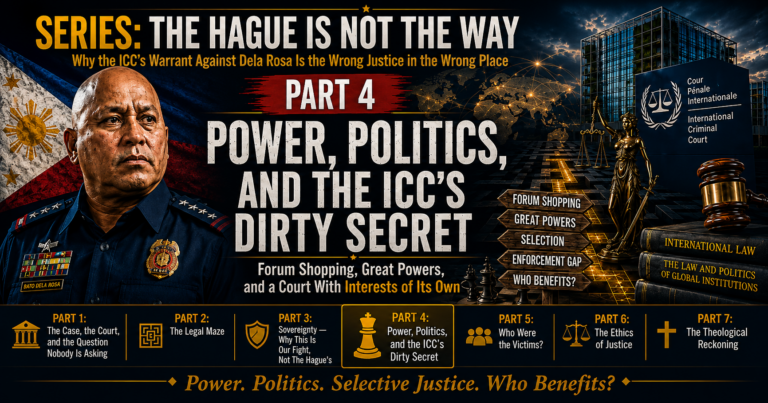
Suppose we grant the ICC every legal point it claims for itself. Harder questions remain. Is it a neutral referee standing above politics, or a political actor with interests of its own? Why did its first fourteen years of investigations all land on one continent? Why do warrants against the powerful gather dust while the machinery worked flawlessly in Manila? And why did cooperation arrive at the exact moment the court’s targets became the administration’s rivals? Part 4 puts the court itself on trial, using political science. The full scholarly paper behind this seven part series, with complete citations and academic analysis, is available for download at the end of this post. A companion podcast episode is also available there for those who prefer listening over reading.
Inspired Text, Unscriptural Stricture
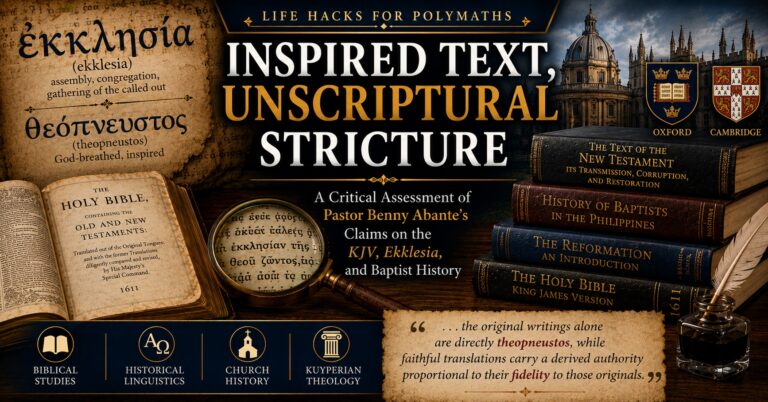
Is a pastor qualified to declare who is and isn’t saved, including men who lived four centuries ago?Is your pastor qualified to declare who is and isn’t saved, including men who lived four centuries ago? Pastor Benny Abante’s viral statements about the King James Version, the Greek word ekklesia, and the Anabaptists contain some important truths, some partial truths, and some significant errors. This article examines each claim fairly and honestly: what he got wrong, what he got partially right, and what he got right. You can download the scholarly paper or listen to the companion podcast episode on Spotify if you prefer to listen rather than read at the end of the post.
Quorum, Power, and the Bending of the Law, Part 2: The Doctrine, the Distortion, and the Deal Behind the Drama.
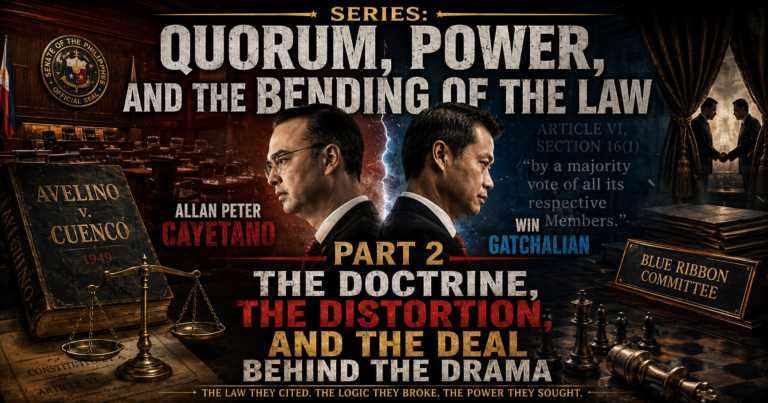
In Part 1, we looked at what happened when twelve senators reorganized the Senate on June 3, 2026. In Part 2, we ask a different question: Did they actually have the legal authority to do it? The senators relied on a 1949 Supreme Court case called Avelino v. Cuenco, but does that case still apply under the 1987 Constitution? This post explains the controversy in plain language, examines a legal argument that many commentators missed, and explores why some believe the real battle was not about impeachment at all, but about control of a major corruption investigation. Beyond constitutional law, we also examine the issue through the lenses of political science, political economy, sociology, philosophy, comparative jurisprudence, and Reformed theology. Each lens helps answer a different question: How do political actors manipulate institutions? What incentives drive their decisions? How is public perception shaped? Does the precedent really fit the facts? And was the Senate being used for its proper purpose? By bringing these perspectives together, we gain a fuller picture of what may have happened on June 3 than constitutional law alone can provide. The complete scholarly paper is available for download at the end of this post. If the Constitution says one thing and politicians say another, who should we believe? And if the rules can be interpreted differently depending on who benefits, what does that mean for ordinary Filipinos?
Quorum, Power, and the Bending of the Law, Part 1: The Session, the Senators, and the Teleserye They All Scripted
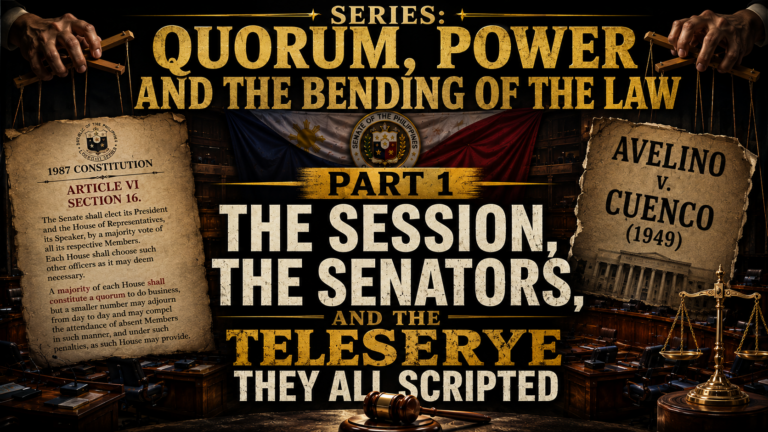
On the afternoon of June 3, 2026, twelve senators reorganized the entire Philippine Senate without the other twelve. They invoked a 1949 Supreme Court case to justify it. This is Part 1 of a two-part series analyzing the crisis from multidisciplinary, interdisciplinary, crossdisciplinary, and transdisciplinary perspectives spanning constitutional law, political science, public choice economics, sociology, philosophy, and Reformed theology. This post covers the full story, the players, the legal argument, and what the flood control corruption have to do with it all. The complete scholarly paper is available for download at the end of this post. If the law can be bent by twelve senators for obvious reasons that has something to do with their self interest, what guarantee do ordinary Filipinos have that it will not be bent again tomorrow?