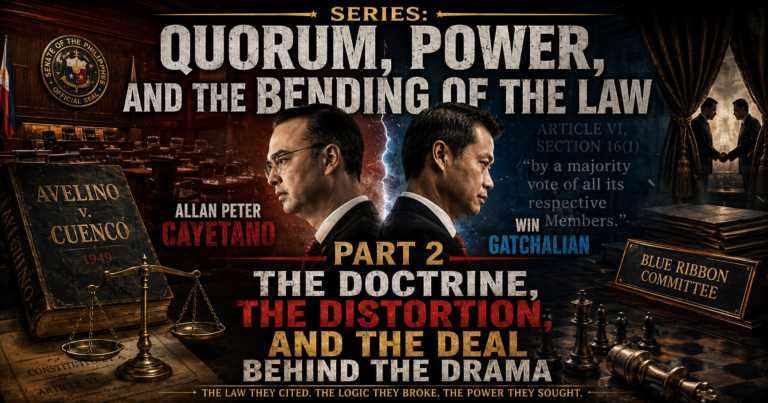
In Part 1, we looked at what happened when twelve senators reorganized the Senate on June 3, 2026. In Part 2, we ask a different question: Did they actually have the legal authority to do it? The senators relied on a 1949 Supreme Court case called Avelino v. Cuenco, but does that case still apply under the 1987 Constitution? This post explains the controversy in plain language, examines a legal argument that many commentators missed, and explores why some believe the real battle was not about impeachment at all, but about control of a major corruption investigation. Beyond constitutional law, we also examine the issue through the lenses of political science, political economy, sociology, philosophy, comparative jurisprudence, and Reformed theology. Each lens helps answer a different question: How do political actors manipulate institutions? What incentives drive their decisions? How is public perception shaped? Does the precedent really fit the facts? And was the Senate being used for its proper purpose? By bringing these perspectives together, we gain a fuller picture of what may have happened on June 3 than constitutional law alone can provide. The complete scholarly paper is available for download at the end of this post. If the Constitution says one thing and politicians say another, who should we believe? And if the rules can be interpreted differently depending on who benefits, what does that mean for ordinary Filipinos?

Multidisciplinary | Cross-Disciplinary | Interdisciplinary | Transdisciplinary.