Life Hacks for Polymaths

Multidisciplinary | Cross-Disciplinary | Interdisciplinary | Transdisciplinary.

  • Facebook
  • Instagram
  • LinkedIn
  • Pinterest
  • YouTube

Welcome, Polymaths!

I’m Zigfred Diaz — polymath, independent scholar, &  lifelong learner integrating multidisciplinary, cross-disciplinary, interdisciplinary & transdisciplinary ideas through a broader theological meta-narrative that serves as my guiding interpretive framework. Feel free to explore.

Powered by Genesis

  • Home
  • About
  • Privacy Policy
  • Archives
  • Categories
    • Book reviews
    • Life Hack for Polymaths
      • Featured Polymaths
      • Life-work Balance
      • Productivity
      • Miscellaneous Ramblings
      • My Life long learnings experiences
    • Business, Entrepreneurship & Leadership
    • Events
    • Financial management & investments
    • Fraud alert
    • Health
    • Hot trends
    • Law, Law Practice, Law Education
    • Making money online, Blogging, SEO
    • Music
    • Politics, Social issues & Current events
    • Reviews
    • Sports
    • Technology
      • Word Press tips
    • Theology, Faith & inspirational
    • Travel and Living
    • Cognitive Archeology
    • Social Work
    • Theology
    • Uncategorized
  • Contact

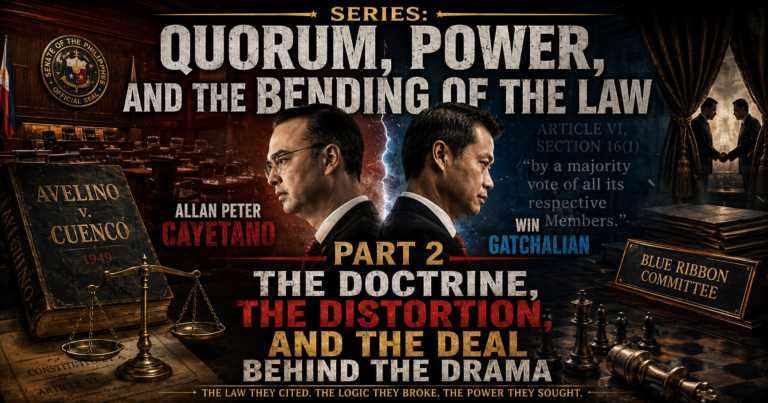
Quorum, Power, and the Bending of the Law, Part 2: The Doctrine, the Distortion, and the Deal Behind the Drama.

June 4, 2026 by Zigfred Diaz Leave a Comment

In Part 1, we looked at what happened when twelve senators reorganized the Senate on June 3, 2026. In Part 2, we ask a different question: Did they actually have the legal authority to do it? The senators relied on a 1949 Supreme Court case called Avelino v. Cuenco, but does that case still apply under the 1987 Constitution? This post explains the controversy in plain language, examines a legal argument that many commentators missed, and explores why some believe the real battle was not about impeachment at all, but about control of a major corruption investigation. Beyond constitutional law, we also examine the issue through the lenses of political science, political economy, sociology, philosophy, comparative jurisprudence, and Reformed theology. Each lens helps answer a different question: How do political actors manipulate institutions? What incentives drive their decisions? How is public perception shaped? Does the precedent really fit the facts? And was the Senate being used for its proper purpose? By bringing these perspectives together, we gain a fuller picture of what may have happened on June 3 than constitutional law alone can provide. The complete scholarly paper is available for download at the end of this post. If the Constitution says one thing and politicians say another, who should we believe? And if the rules can be interpreted differently depending on who benefits, what does that mean for ordinary Filipinos?

Filed Under: Cross-disciplinary, Hot trends, Interdisciplinary, Law, Law, Law Practice, Law Education, Multidisciplinary, My Life long learnings experiences, Philosophy, Political Science, Politics, Social issues & Current events, Sociology, Theological meta-framework, Transdisciplinary Tagged With: Alan Peter Cayetano, Avelino v. Cuenco, Blue Ribbon Committee, Comparative Jurisprudence, constitutional crisis, Constitutional Interpretation, constitutional law, Constitutional Theory, Democratic Governance, flood control scandal, Institutional Subversion, June 3 Senate Session, Jurisprudence, legal analysis, Legislative Governance, Philippine Constitution, Philippine governance, Philippine politics, Philippine Public Policy, Philippine Senate, Political Accountability, political analysis, Political Drama, Political Economy, Power and the Bending of the Law, Public Theology, Quorum, Reformed Political Theology, Rule of Law, Sara Duterte impeachment, Senate Committees, Senate Controversy, Senate leadership, Senate President Pro Tempore, Senate quorum, Senate Rules, Senate Teleserye, Separation of Powers, Win Gatchalian

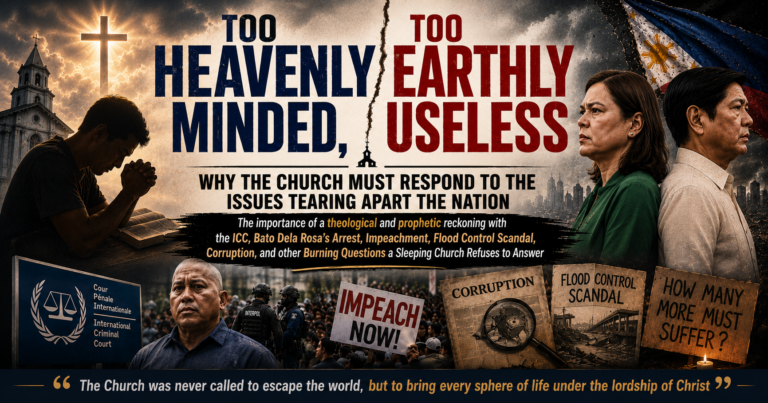
Too Heavenly Minded, Too Earthly Useless?- Why the Church Must Respond to the Issues Tearing Apart the Nation
May 22, 2026 by Zigfred Diaz 2 Comments

“What is this going to profit the body of Christ?” That question, asked in response to a theological paper on the ICC controversy and Bato dela Rosa’s arrest, reveals a deeper problem within the modern Church itself. Somewhere along the way, many Christians began treating justice, governance, abuse of power, and national moral responsibility as “too political” for the gospel. But Scripture tells a different story. The prophets confronted kings. John the Baptist rebuked rulers. Paul reasoned about justice before governors. The Church was never called to escape the world, but to bring every sphere of life under the Lordship of Christ. This article is a theological and prophetic reckoning with the burning issues tearing apart the nation, and a challenge to a sleeping Church that too often remains silent while society collapses around it

Filed Under: Hot trends, Miscellaneous Ramblings, Politics, Social issues & Current events, Theological meta-framework, Theology, Faith & inspirational Tagged With: Abraham Kuyper, Acts 24, Amos, Augustine, Bato Dela Rosa, biblical justice, body of Christ, Calvin, Christian political theology, Christian response to injustice, Christian scholarship, Christopher Wright, church and justice, church and politics, church and state, church silence, Dietrich Bonhoeffer, drug war, drug war victims, Duterte drug war, extrajudicial killings, Filipino Christianity, Filipino Christianity and politics, Filipino church, Filipino pastors, full gospel, gospel and justice, gospel and social justice, Hague, human dignity, hyper-spiritualized Christianity, ICC, ICC warrant, imago Dei, institutional accountability, interdisciplinary theology, International Criminal Court, Jeremiah, Jeremiah 22:16, John Howard Yoder, justice, Lordship of Christ, Luke 4:18, Micah 6:8, missio Dei, moral unraveling, multidisciplinary theology, nation and church, Nicholas Wolterstorff, Oliver O'Donovan, pastoral responsibility, Philippine Constitution, Philippine governance, Philippine politics, Philippine sovereignty, political theology, poor and marginalized, prophetic church, prophetic imperative, prophetic mandate, prophets and justice, Romans 13, Ronald Dela Rosa, sovereignty, theological mandate, theological reckoning, theology, transdisciplinary theology, war on drugs Philippines