If you prefer to listen rather than read, you can find the companion podcast episode on Spotify near the end of this post.
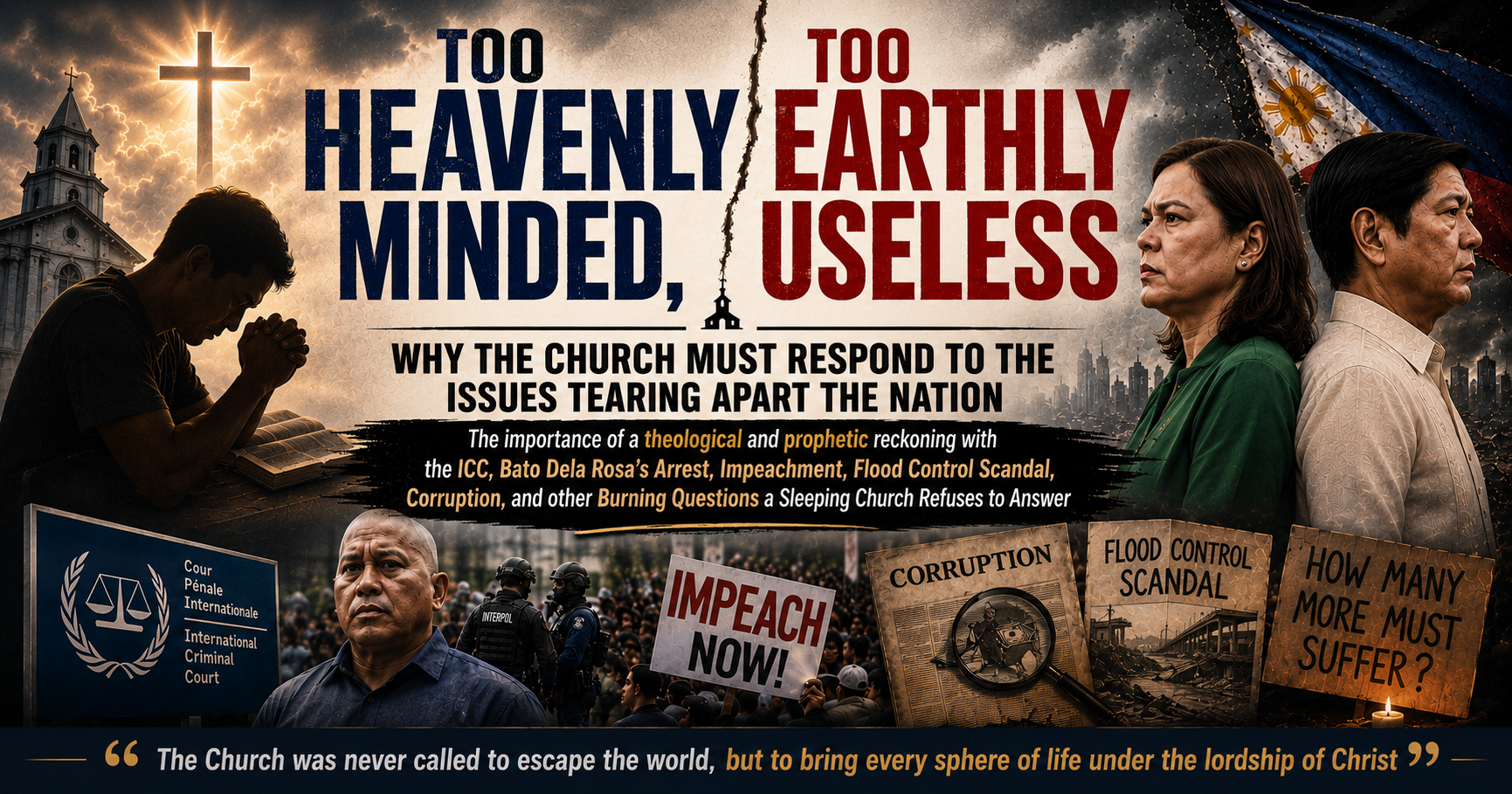
The importance of a theological and prophetic reckoning with the ICC, Bato Dela Rosa’s Arrest, Impeachment, Corruption, Flood control scandal and other Burning Questions a Sleeping Church Refuses to Answer
“I thought this was a room for pastors. Why do you post this Hague stuff? Are you about the father’s business and knowing Jesus and making him known? What is this going to profit the body of Christ by posting this stuff? Get focused, the devil comes to kill, steal and destroy. Jesus came to bring life. Preach the gospel. Get focused.”
A fellow pastor, in a group chat for pastors
A
pastor in a group chat for pastors posted this challenge in response to a blopost and a paper I wrote on the ICC case involving Ronald dela Rosa and the broader question of Philippine sovereignty, extrajudicial killings, and international criminal accountability. It is a sincere challenge, and it deserves a sincere, serious, and direct answer. It will not be dismissed. It will not be treated unkindly. But it will be answered honestly, because the stakes of getting this wrong, theologically and pastorally, are far too high.
There is a real question buried inside the complaint: does any of this actually matter for the church? And the answer, drawn from Scripture, from church history, and from the weight of Christian theological tradition, is an unambiguous yes. Here is why.
I. The Question Itself Reveals the Problem
The question, “What is this going to profit the body of Christ?” assumes that engaging questions of justice, sovereignty, law, governance, and institutional accountability is somehow outside the scope of pastoral concern. This assumption is not biblical. It is not historical. And it is not theologically and historico-theologically defensible.
What it represents is what theologians call hyper-spiritualized Christianity, a truncated gospel that restricts Christ’s Lordship to the interior life of the individual while ceding the public square, political institutions, legal systems, and national moral life to forces that operate without theological accountability. That is not the gospel of the New Testament. It is not the tradition of the great reformers and theologians. And it is emphatically not what the prophets modeled.
II. The Bible Has Always Engaged Power, Law, and Justice
The pastor invoked John 10:10, “the devil comes to kill, steal and destroy.” This verse is, ironically, the most direct biblical argument for engaging the Dela Rosa issue. Alleged extrajudicial killings, the alleged slaughter of thousands of Filipinos in the streets without due process, without trial, without the protection of law, are kill, steal and destroy in its most literal and horrifying form. If the church cannot connect that verse to actual bodies in actual streets, it is preaching an abstraction, not the gospel.
Scripture does not model a disengaged faith:
What Scripture Actually Models
- The Prophets did not merely call people to personal piety. Amos condemned the specific legal and economic crimes of Israel’s ruling class, the selling of the poor for silver, the trampling of the needy, the corruption of the courts (Amos 2:6,7; 5:10,12). Isaiah called out corrupt magistrates by name (Isa. 1:23). Micah declared the three-part summary of covenant faithfulness: “to do justice, to love kindness, and to walk humbly with your God” (Mic. 6:8), and justice comes first.
- Jeremiah confronted Jehoiakim, king of Judah, for building his palace with forced labor and bloodshed, and then the text delivers one of the most startling equations in all of Scripture: “Did not your father eat and drink and do justice and righteousness? Then it was well with him. He judged the cause of the poor and needy; then it was well. Is not this to know me? declares the LORD” (Jer. 22:15,16). Knowing God and doing justice are not parallel tracks. They are the same act.
- John the Baptist did not tell Herod to have a personal quiet time. He confronted the ruler directly about specific acts of moral and legal transgression, and it cost him his head (Mark 6:18).
- Paul did not simply evangelize before Roman authorities. He reasoned with Felix about “justice, self-control, and the coming judgment” (Acts 24:25). He invoked his rights as a Roman citizen (Acts 22:25,29). He engaged the legal and political structures of the empire as a thinking, theologically informed participant.
- Jesus Himself was tried under political and legal structures. His death was a judicial act of the Roman state, carried out under the authority of a Roman governor. The resurrection is, among other things, God’s verdict on the verdict of Caesar. To preach “Jesus is Lord” (Phil. 2:11) is already a public, civilizational claim, because it means Caesar is not.
- Paul instructed believers to pray for kings and all those in authority in 1 Timothy 2, it was not merely for their personal salvation or spiritual matters, but “that we may lead peaceful and quiet lives in all godliness and holiness.” In other words, the condition of public life affects justice, peace, human flourishing, and even the environment in which the gospel advances. Prayer and prophetic engagement are not enemies. Historically, the Church has always done both.
III. What Does This Profit the Body of Christ? A Direct Answer
Here is the answer, plainly stated: the body of Christ in the Philippines sat largely silent while thousands of its poorest, most vulnerable members were allegedly killed in the streets without due process. Most likely, some of those victims were from communities where the church ministers. Some were probably were sons, fathers, neighbors and loved ones of believers. The drug war targeted the margins, the exact people the gospel of Luke describes as the special objects of Christ’s concern (Luke 4:18; 7:22).
If the body of Christ cannot name what happened, cannot theologically analyze it, cannot speak prophetically into it, and cannot equip its members to think faithfully about justice, accountability, sovereignty, and the limits of state power, then the body of Christ has failed the very people it claims to serve. That is what this profits the body of Christ.
Consider what is actually at stake in the ICC case:
| The Question | Why It Is Theological |
|---|---|
| Justice | Were the killings wrong, and who bears moral and legal responsibility before God? |
| Human Dignity | Do the victims, most of them poor and nameless, matter before God and before the law? |
| Sovereignty | What are the proper limits of state power, and what recourse exists when a state fails its people? |
| Institutional Accountability | Are governments, like individuals, morally accountable before God? |
| Constitutional Order | What does it mean to govern justly under a constitutional framework? |
These are not secular distractions. These are profoundly theological questions. They are the questions Augustine wrestled with in The City of God. They are the questions Calvin addressed in his Institutes on civil government (Book IV, Chapter 20). They are the questions that drove Abraham Kuyper to declare his famous principle: “There is not one square inch of the entire creation about which Jesus Christ does not cry out, ‘This is mine! This belongs to me!'” (Kuyper, 1880).
IV. Why a Multidisciplinary, Transdisciplinary, Theological Meta-Framework?
This is precisely why the paper was written not as a simple opinion piece, but through a multidisciplinary, cross-disciplinary, interdisciplinary, and normative transdisciplinary framework, integrated within a theological meta-framework grounded in Scripture and Christian theology.
Understanding the Framework
Multidisciplinary
Theology, law, political science, anthropology, ethics and other disciplines each contribute their own tools and conclusions to the same problem without fully merging.
Cross-disciplinary
The lens of one discipline, specifically theological and ethical norms, is applied as a critical lens across the others.
Interdisciplinary
Frameworks are merged. Theological ethics and international humanitarian law speak to each other, producing conclusions neither could reach alone.
Normative Transdisciplinary
Theological and biblical norms govern and integrate all other frameworks. Theology is not one voice among many. Theology governs the analysis itself.
As far as is known, no pastor, no church, and no parachurch organization in the Philippines has engaged the Dela Rosa case, the ICC question, the Duterte case, the flood control scandal, the impeachment of VP Sara and other burning issues tearing this nation apart at this level and in this manner. That is not said boastfully. It is said as a statement of responsibility. If the church does not think at this level about these questions, who will?
Read the Full Series
The paper being referenced here has been serialized into a seven-part blog series. Parts 1 and 2 are now available. The remaining parts will be published progressively, and links will be activated as each part goes live.
Part 1
The Case, the Court, and the Question Nobody Is Asking
Live
Part 2
The Legal Maze: Jurisdiction, Withdrawal, and the Dissent Nobody Wants to Discuss
Live
Sovereignty, the State, and the Limits of International Power
Coming Soon
Power, Politics, and the ICC’s Blind Spots
Coming Soon
Who Were the Victims? Human Dignity, Poverty, and the Drug War’s Hidden Story
Coming Soon
What Justice Really Looks Like: A Theological and Constitutional Reckoning
Coming Soon
Conclusion: A Church That Thinks, A Gospel That Costs Something
Coming Soon
V. The Danger of “Just Preach the Gospel”
There is a real and documented historical danger in the kind of piety being advocated, however sincerely it is offered.
When Christians in Germany were told to “just preach the gospel” and stay out of politics in the 1930s, the result was the Deutsche Christen, a church co-opted by the Nazi state, its silence purchased with the promise of institutional peace. It took Barmen (1934), Bonhoeffer, and the Confessing Church to declare that the Lordship of Christ cannot be partitioned, that there is no zone of human life, including the state’s use of lethal force, over which Christ’s claim does not extend.
“Silence in the face of evil is itself evil: God will not hold us guiltless. Not to speak is to speak. Not to act is to act.”
Dietrich Bonhoeffer, Letters and Papers from Prison (1953)
When the church in Latin America was told to focus on souls and leave politics alone, the result was an institution that blessed military dictatorships and looked away from disappearances, torture, and mass graves. It took a generation of theological reckoning to force the question back onto the table: does the gospel have anything to say to the poor who are being killed by their own government?
The answer, from Scripture, from church history, and from the tradition of Christian political theology, is an emphatic yes.
A gospel that speaks only to personal salvation while remaining silent about justice, governance, abuse of power, institutional fallenness, and national moral responsibility is not the full counsel of God (Acts 20:27). It is a partial gospel. A domesticated gospel. A gospel that threatens no power, challenges no injustice, and costs the church nothing, which is precisely why it changes nothing.
VI. A Word to the Pastor Who Asked the Question
The pastor who raised this objection is, no doubt, a sincere man of God. The concern for focus, for gospel clarity, for not being distracted by the noise of politics, comes from a genuine place. That sincerity is acknowledged and respected. But sincerity is not the same as correctness, and good intentions do not substitute for theological rigor.
The paper in question explicitly argues that extrajudicial killing is wrong. That the victims matter. That accountability is necessary. And that all institutions, whether governments or international courts, are fallen and morally accountable before God. The question it examines is not whether justice matters, but what justice rightly looks like under constitutional order, sovereignty, moral theology, and biblical principles of authority and accountability. That is not partisan propaganda. That is Christian scholarship doing what Christian scholarship is supposed to do.
What the pastor calls a distraction from the gospel is, in the tradition of Amos, Jeremiah, Augustine, Calvin, Bonhoeffer, and Kuyper, one of the most ancient and faithful expressions of it. The church has always spoken to power, always named injustice, and always insisted that the Lordship of Christ extends to kings, courts, constitutions, and the use of lethal force by the state.
A pastoral framework that is too narrow to see that questions of justice, sovereignty, governance, law, and institutional accountability fall under the Lordship of Christ is not a framework that needs defending. It is a framework that needs expanding. The body of Christ in the Philippines deserves pastors who think at the full breadth of what Scripture demands, not at the comfortable minimum that costs nothing and offends no one.
Any pastor who experiences discomfort with this position is of course entirely free not to read the paper or to engage anybody regarding this matter. But those who do will find that this is not a distraction from the gospel, but one of the most serious attempts by a Filipino Christian scholar, theologian and thinker to bring the full weight of Scripture, theology, and Christian tradition to bear on one of the most consequential moral and legal questions facing the Filipino people today.
The Father’s business includes the widow, the orphan, the stranger, and the allegedly extrajudicially killed. It always has. And the church that forgets this does not need to be more focused. IT NEEDS TO REPENT!
Listen to the Companion Podcast
The Deep Dive:Too Heavenly Minded, Too Earthly Useless?- Why the Church Must Respond to the Issues Tearing Apart the Nation
Prefer to listen instead of read? This episode walks through the same analysis in conversational form. Listen below on Spotify.
Don’t have Spotify yet? It’s free to download on iOS, Android, and desktop. While you’re there, hit Follow on zdiaz.com | Life Hacks for Polymaths: The Deep Dive so new episodes land in your library automatically.
References
Augustine of Hippo. (2003). The city of God (H. Bettenson, Trans.). Penguin Classics. (Original work published 426 CE)
Barmen Declaration. (1934). The theological declaration of Barmen. In The book of confessions. Presbyterian Church (USA).
Bonhoeffer, D. (1997). Letters and papers from prison (E. Bethge, Ed.). Touchstone. (Original work published 1953)
Calvin, J. (1960). Institutes of the Christian religion (F. L. Battles, Trans., Vol. 2, Book IV, Ch. 20). Westminster John Knox Press. (Original work published 1559)
Kuyper, A. (1998). Sphere sovereignty. In J. D. Bratt (Ed.), Abraham Kuyper: A centennial reader (pp. 461,490). Eerdmans. (Original work published 1880)
Marshall, P. (2002). God and the constitution: Christianity and American politics. Rowman & Littlefield.
Moltmann, J. (1974). The crucified God: The cross of Christ as the foundation and criticism of Christian theology (R. A. Wilson & J. Bowden, Trans.). Harper & Row.
O’Donovan, O. (1996). The desire of the nations: Rediscovering the roots of political theology. Cambridge University Press.
Stott, J. R. W. (2006). Issues facing Christians today (4th ed.). Zondervan.
Wolterstorff, N. (2008). Justice: Rights and wrongs. Princeton University Press.
Wright, C. J. H. (2006). The mission of God: Unlocking the Bible’s grand narrative. IVP Academic.
Yoder, J. H. (1994). The politics of Jesus: Vicit Agnus Noster (2nd ed.). Eerdmans.

Thank you, Sir. This is a rich material I need. Have a great day.
You are most welcome! Glad to be of service to the body of Christ.