Series: The Hague Is Not The Way
Why the ICC’s Warrant Against Dela Rosa Is the Wrong Justice in the Wrong Place
A Comprehensive Multidisciplinary, Cross-Disciplinary, Interdisciplinary and Normative Transdisciplinary Scholarly Paper
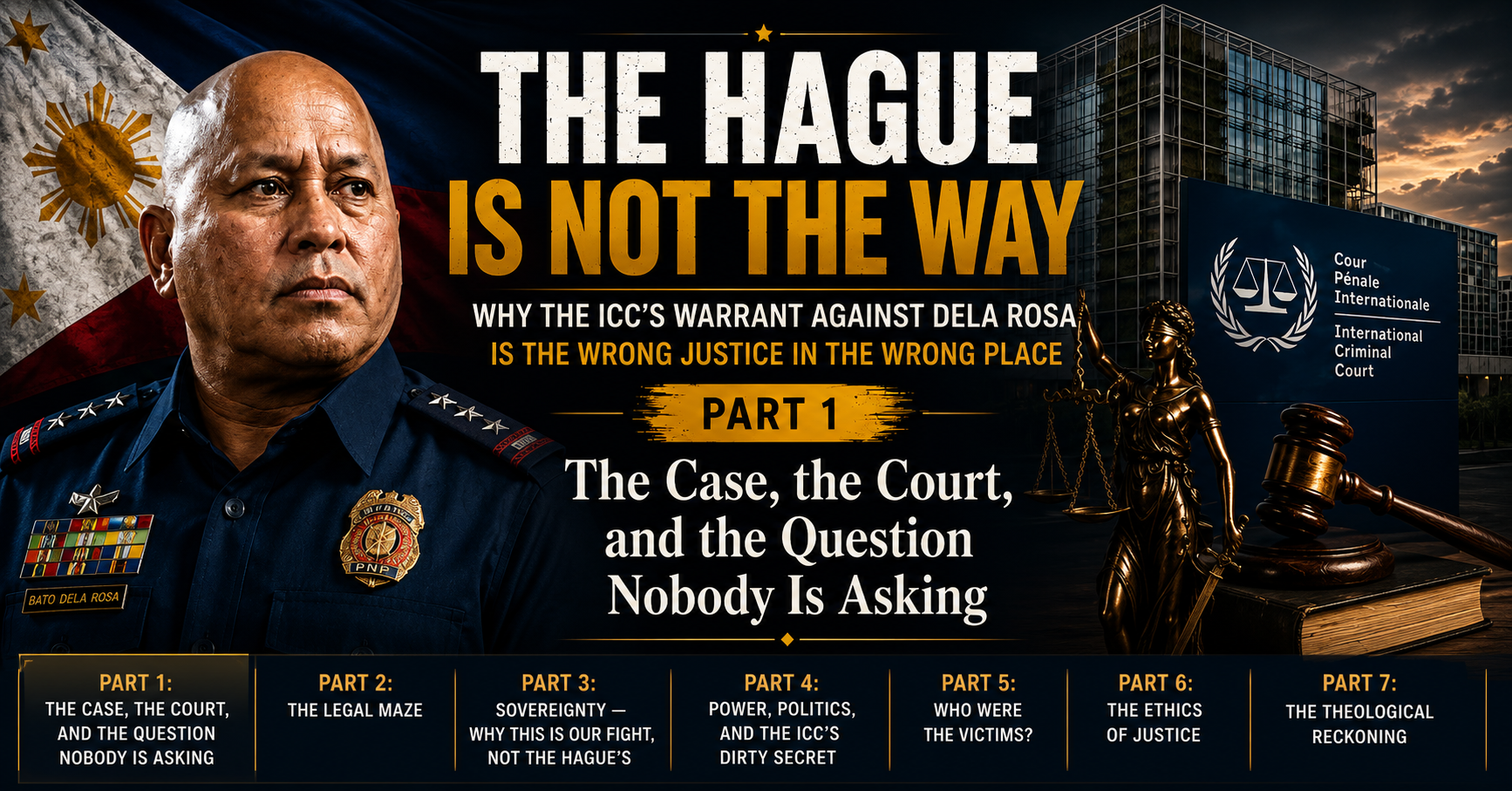
Part 1 of 7: The Case, the Court, and the Question Nobody Is Asking |
Part 2: The Legal Maze |
Part 3: Sovereignty — Why This Is Our Fight, Not The Hague’s |
Part 4: Power, Politics, and the ICC’s Dirty Secret |
Part 5: Who Were the Victims? |
Part 6: The Ethics of Justice |
Part 7: The Theological Reckoning
This blog post is a plain-language, easy-to-read version of a longer scholarly paper. If you prefer a more detailed, fully documented, and academically rigorous treatment of these issues, the complete scholarly paper is available for download at the end of this post. For those who prefer listening rather than reading, a companion Spotify podcast covering the entire series is also available near the end of this post.
The Philippines is watching one of its senators face arrest by a foreign court for crimes allegedly committed on Philippine soil, against Filipino victims, under a Philippine government. Before we debate whether Dela Rosa is guilty or innocent, we should ask a more fundamental question: is this even the right court?
On November 7, 2025, the International Criminal Court issued an arrest warrant for Senator Ronald “Bato” Dela Rosa, former Chief of the Philippine National Police, for crimes against humanity allegedly committed during the Duterte administration’s drug war. Within 24 hours, the Philippine Senate went into closed session. The President’s spokesperson called it an affront. Former President Duterte’s allies called it a political persecution. Human rights groups called it long overdue.
Everyone, it seemed, had an opinion. Very few had a framework.
This series is a framework. It is not a defense of Ronald Dela Rosa. It is not a defense of the drug war. Let me be direct: extrajudicial killing is wrong. Every person who died without trial, without due process, and without justice was a human being made in the image of God, and their deaths represent a moral failure that demands accountability. That is not in dispute here.
What is in dispute is this: who should deliver that accountability, through what process, and in what forum?
The paper this series is based on, The Hague Is Not The Way: Why the ICC’s Warrant Against Dela Rosa Is the Wrong Justice in the Wrong Place, is a 62-page comprehensive multidisciplinary, cross-disciplinary, interdisciplinary and normative transdisciplinary scholarly paper. It examines those questions through nine distinct academic lenses: law, sovereignty, political science, international relations theory, sociology, anthropology, post-colonial theory, public health and criminology, and ethics. It then integrates all of those lenses through a theological meta-framework that provides the author’s governing interpretive architecture. This first post introduces the problem, the stakes, and the methodological approach. The remaining six posts will go lens by lens through the full argument.
A note on the presumption of innocence: This paper and series treat Dela Rosa, Duterte, and all others named as presumed innocent until a competent court finds otherwise. The analysis does not assume guilt. It argues about forum, process, and sovereignty.
The Numbers Behind the Noise
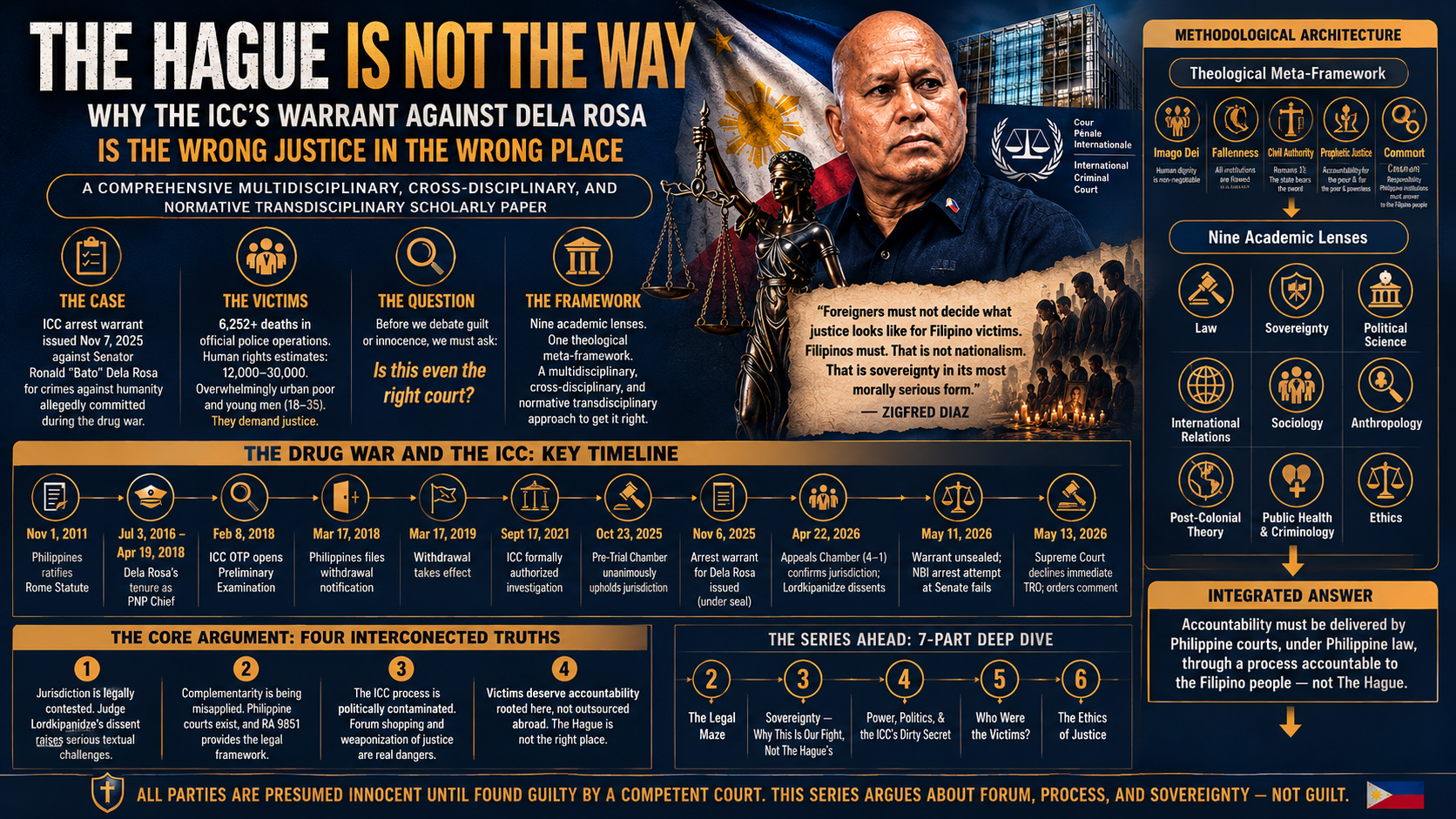
The drug war was not a rumor. It produced documented, measurable death at a scale that demands accounting. The government’s own data placed the number of deaths during police anti-drug operations at approximately 6,252 between July 2016 and May 2022 (Philippine Drug Enforcement Agency, 2022). Human rights organizations, using broader methodologies that included deaths by unknown assailants, estimated figures between 12,000 and 30,000 (Human Rights Watch, 2017; Amnesty International, 2019).
The geographic and demographic pattern was not random. The dead were overwhelmingly from urban poor communities. They were predominantly young men aged 18 to 35 (Carlos, 2020). They were not drawn from the political, economic, or social classes that control the institutions that would investigate their deaths.
The Drug War and the ICC: Key Data Points
| Indicator | Figure | Source |
|---|---|---|
| Deaths in official police operations (drug war) | ~6,252 | PDEA, 2022 |
| Human rights organizations’ estimates (broader methodology) | 12,000–30,000 | HRW, 2017; AI, 2017a |
| Dela Rosa’s tenure as PNP Chief (alleged operational period) | July 3, 2016 – April 19, 2018 | ICC, 2026a |
| Philippines ratifies Rome Statute | November 1, 2011 | Rome Statute, Art. 127 |
| ICC OTP opens Preliminary Examination | February 8, 2018 | ICC, 2021a |
| Philippines files withdrawal notification | March 17, 2018 | Rome Statute, Art. 127 |
| Philippines’ withdrawal takes effect | March 17, 2019 | Pangilinan v. Cayetano, 2021 |
| ICC formally authorized investigation | September 15, 2021 | ICC, 2021a |
| Pre-Trial Chamber unanimously upholds jurisdiction | October 23, 2025 | ICC, 2025a |
| Arrest warrant for Dela Rosa issued (under seal) | November 6, 2025 | ICC, 2026a |
| Duterte arrested and transferred to The Hague | March 12, 2025 | ICC, 2026b |
| Appeals Chamber (4-1) confirms jurisdiction; Lordkipanidze dissents | April 22, 2026 | ICC, 2026b; 2026c |
| Dela Rosa warrant unsealed; NBI arrest attempt at Senate fails | May 11, 2026 | Al Jazeera, 2026; ICC, 2026a |
| Philippine Supreme Court declines immediate TRO; orders comment | May 13, 2026 | Philstar Life, 2026 |
Note: All named parties are presumed innocent until found guilty by a competent court. The figures above represent documented official and estimated data.
Those numbers carry moral weight. They are why this conversation matters. And they are also why getting the forum right matters, because justice done in the wrong court, through the wrong process, with compromised political motivations, is not justice fully delivered.
Why Nine Lenses? Because One Is Never Enough
Most commentary on the Dela Rosa case picks a lane: legal experts debate jurisdictional technicalities; human rights advocates foreground the victims; political analysts see a Philippine power struggle; Duterte loyalists call it foreign interference. Each of these perspectives captures something real. None of them captures the whole.
The paper this series is based on does something different. It uses nine distinct academic disciplines simultaneously, not as competing analyses that contradict each other, but as complementary lenses that illuminate different dimensions of the same problem. Think of it like a medical diagnosis: a cardiologist, a neurologist, and an immunologist looking at the same patient will each find something the others might miss. The most accurate diagnosis comes from the team, not from any single specialist.
💡 Understanding the Methodology
Multidisciplinary, Crossdisciplinary, Interdisciplinary, and Transdisciplinary: What’s the Difference?
Scholars have three ways of working across academic fields, and they are not the same thing.
Multidisciplinary work places several disciplines side by side, each contributing its own analysis without fundamentally changing the others. Imagine five professors on a panel, each giving a separate talk about the same event from their own field. They don’t really talk to each other.
Cross-disciplinary work occurs when one discipline applies its concepts, methods, or analytical tools to another field without fully integrating the two into a unified framework. One discipline temporarily “crosses into” another to illuminate a problem from a different angle. Imagine a political scientist using psychological theories to explain voter behavior, or a theologian employing legal reasoning to analyze questions of sovereignty. The disciplines interact, but one primarily remains the interpretive driver while borrowing insight from the other.
Interdisciplinary work goes further: the findings of one discipline actually reshape the questions asked by another. The legal analysis and the political science analysis push each other to ask different questions than they would have asked alone. There is genuine conversation between the fields.
Transdisciplinary work goes furthest: it produces a synthetic framework that transcends all the individual disciplines and generates insights that none of them could have produced alone. The whole becomes greater than the sum of its parts.
This paper operates primarily in the interdisciplinary register, with transdisciplinary aspirations at the normative level. The theological meta-framework is what provides the integrating, governing architecture that none of the nine academic lenses can supply on their own (Jahn et al., 2012; Klein, 2001).
Here is a map of all nine lenses and the central question each one asks about the Dela Rosa case:
| # | Disciplinary Lens | Central Question It Asks | Core Finding |
|---|---|---|---|
| 1 | Law | Does the ICC actually have valid jurisdiction after the Philippines withdrew from the Rome Statute? | Jurisdiction is legally contested; Judge Lordkipanidze’s dissent raises serious textual challenges |
| 2 | Sovereignty | Is the ICC’s intervention consistent with or an affront to Philippine constitutional sovereignty? | The Philippine Constitution establishes domestic courts as the primary and sovereign forum |
| 3 | Political Science | Who is politically benefiting from the ICC referral, and does that contaminate the process? | The Marcos-ICC dynamic constitutes forum shopping for political purposes |
| 4 | International Relations | Whose interests does the ICC actually serve? | The ICC reflects organized hypocrisy: selective enforcement shaped by powerful state interests |
| 5 | Sociology | What does the ICC’s role as a field of power, prestige, and legal capital tell us about its behavior? | The ICC’s legitimacy derives partly from its institutional performance of universality, which it does not consistently deliver |
| 6 | Anthropology | Does the ICC’s framework understand the cultural and relational context in which these crimes occurred? | International justice frameworks often erase local context and survivor agency |
| 7 | Post-Colonial Theory | Is this a genuinely universal justice system, or is it a new form of legal imperialism? | The savages-victims-saviors pattern describes ICC practice in the Global South |
| 8 | Public Health & Criminology | Who were the victims, what structural conditions made them vulnerable, and does the ICC’s process center them? | Structural violence shaped who died; the ICC process risks recentering institutions over communities |
| 9 | Ethics | Does a just war framework or utilitarian calculus justify the ICC’s intervention? | The proportionality and right intention criteria are not clearly satisfied by ICC proceedings of contested legitimacy |
The Governing Framework Above All Others
The nine disciplinary lenses do the analytical heavy lifting. But what integrates them into a single coherent position is a theological meta-framework rooted in the author’s scholarly identity as a polymath who approaches all questions through a theologically grounded interpretive architecture.
This is not religion inserted into politics. It is the author’s explicit, confessional starting point: that theology provides the normative foundation upon which all of the other disciplines ultimately rest, whether they acknowledge that foundation or not. Legal concepts like due process presuppose that human beings have inherent dignity. Political science concepts like legitimate authority presuppose a standard against which authority is measured. These presuppositions are ultimately theological, and making them explicit produces more honest scholarship.
💡 Understanding the Framework: The Theological Meta-Narrative
What Is a Theological Meta-Framework and Why Does It Matter Here?
A meta-framework is not one more lens alongside the others. It is the interpretive architecture above the lenses that determines how all of them are weighed and synthesized. Think of it as the operating system that runs the applications.
The theological meta-framework in this paper operates through six core doctrinal concepts:
| Concept | What It Means for This Analysis |
|---|---|
| Imago Dei | Every person who died in the drug war was made in the image of God. That is the irreducible moral anchor of this entire analysis. |
| Fallenness of Institutions | Both the ICC and the Philippine government are fallen institutions, capable of both justice and injustice. Neither is automatically trustworthy. |
| Romans 13: Civil Authority | The state bears the sword for the protection of the people it governs, not for political survival or foreign legal performance. |
| Prophetic Justice Tradition | Accountability for the poor and powerless is a biblical mandate, but it must be done rightly, not merely performatively. |
| Common Grace | Even imperfect secular institutions, including the ICC and Philippine Courts, can be instruments of partial justice. The question is which instrument is most appropriate here. |
| Covenant Responsibility | Filipino institutions have a covenant responsibility to the Filipino people. Outsourcing that responsibility to The Hague is not faithfulness. It is abdication. |
The paper’s central conclusion flows from this framework: accountability for the drug war must be delivered by Filipino institutions, under Filipino law, through a process accountable to the Filipino people, because that is what covenant responsibility and genuine sovereignty require.
Figure 1: How This Paper Works
Methodological Architecture: Nine Lenses, One Governing Framework
Theological Meta-Framework
Imago Dei | Fallenness | Civil Authority | Prophetic Justice | Common Grace | Covenant
Accountability must be delivered by Philippine courts, not The Hague.
■ ■ ■
The Central Argument: Stated Plainly
Before diving into the legal and theoretical complexities in the parts that follow, it is worth stating the paper’s central conclusion in plain language so readers always know where we are going.
The paper argues four interconnected things:
First: The ICC’s jurisdiction over the Philippines after its 2019 Rome Statute withdrawal is legally contested in ways that the majority ruling does not fully resolve. The dissenting opinion of Judge Gocha Lordkipanidze raises serious textual arguments about Article 127(2) of the Rome Statute that deserve rigorous engagement, not dismissal (International Criminal Court, 2026a).
Second: Even if the ICC’s jurisdiction is legally valid, the complementarity principle that is supposed to be the ICC’s safety valve against overreach is not being applied correctly. The Philippines’ own Republic Act 9851 provides a domestic legal framework for prosecuting crimes against humanity. The question is not whether Philippine courts can handle this, but whether there is the political will to make them do so.
Third: The ICC’s investigation and warrant cannot be fully separated from the political context that produced them. The Marcos administration’s cooperation with the ICC, against its predecessor’s government, at a time of intense factional warfare in Philippine politics, raises legitimate questions about forum shopping and the weaponization of international justice for domestic political purposes (Teehankee, 2016).
Fourth: The victims deserve better than this. They deserve accountability that is rooted in their communities, delivered through a process accountable to their families, and grounded in the Philippine legal tradition that is supposed to serve them. The Hague is not that place.
💡 Understanding the Theory: The Complementarity Principle
What Is Complementarity, and Why Does It Matter?
The ICC was never designed to be a replacement for national courts. It was designed to be a court of last resort, stepping in only when a country’s own courts are genuinely unable or unwilling to prosecute serious crimes. This principle is called complementarity, and it is embedded in Article 17 of the Rome Statute.
Think of it this way: if a city has a local fire department, the national emergency service does not show up and take over every fire. It steps in only when the local department has genuinely failed or does not exist. The ICC is supposed to be the national emergency service. It is only supposed to show up when the local court system has truly failed.
The paper argues that complementarity is being misapplied in the Philippines case for three reasons:
1. The Philippines has domestic legislation (Republic Act 9851) that criminalizes crimes against humanity and provides a legal basis for prosecution.
2. Philippine courts are operational, not collapsed. They may be politically compromised, but that is a different problem requiring a different solution.
3. The Marcos administration’s active cooperation with the ICC against a political rival raises questions about whether the complementarity standard is being applied as a genuine legal test or as a political instrument.
Source: Rome Statute of the International Criminal Court, Art. 17 (1998); Schabas, W. A. (2016). The International Criminal Court: A commentary on the Rome Statute. Oxford University Press.
■ ■ ■
A First Look at the Jurisdiction Question
The ICC’s jurisdiction over the Philippines after its 2019 withdrawal is not as settled as its proponents claim. The full legal analysis comes in Part 2 of this series, but it is worth sketching the basic problem here so readers understand what is at stake.
The Philippines ratified the Rome Statute in 2011. In March 2018, then-President Duterte announced withdrawal from the treaty after the ICC opened a preliminary examination into the drug war. The withdrawal became effective on March 17, 2019, meaning the Philippines ceased to be a member state of the Rome Statute on that date.
The ICC’s Pre-Trial Chamber authorized a full investigation in September 2021, more than two years after the withdrawal became effective. In October 2025, the Pre-Trial Chamber ruled unanimously that the ICC retains jurisdiction over crimes committed during the Philippines’ membership period (November 1, 2011 to March 17, 2019), notwithstanding the withdrawal. The Appeals Chamber affirmed that ruling in April 2026 (International Criminal Court, 2026b).
However, Judge Gocha Lordkipanidze filed a partly dissenting opinion that raises a serious textual challenge. His argument, grounded in the plain language of Article 127(2) of the Rome Statute, is that the majority’s interpretation stretches the treaty’s text beyond what its ordinary meaning supports. The paper takes that dissent seriously, not as a basis for dismissing the ICC’s jurisdiction, but as evidence that the jurisdictional question is genuinely contested in ways that matter for how we evaluate the legitimacy of these proceedings (International Criminal Court, 2026a).
💡 Understanding the Law: Article 127 of the Rome Statute
What Does “Withdrawal” Actually Mean Under International Law?
When a country joins an international treaty, it agrees to be bound by its rules. When a country withdraws from a treaty, it stops being bound by new rules going forward. The question is what happens to cases and investigations that were already underway before the withdrawal.
Article 127(2) of the Rome Statute says that withdrawal does not relieve a state of obligations that arose during its membership. The ICC majority interprets this to mean it can continue investigating and prosecuting crimes committed while the Philippines was a member. Judge Lordkipanidze’s dissent argues that this reading stretches the plain language too far: once a state has withdrawn and a formal investigation has not yet been authorized, the treaty’s ordinary meaning suggests the state’s obligations do not extend indefinitely into the future.
Here is the critical timeline that makes this concrete:
| Event | Date |
|---|---|
| Alleged crimes (Dela Rosa as PNP Chief) | July 2016 – April 2018 |
| Philippines’ withdrawal effective | March 17, 2019 |
| ICC formally authorized investigation | September 15, 2021 |
| Pre-Trial Chamber rules on jurisdiction | October 2025 |
| Appeals Chamber affirms jurisdiction | April 22, 2026 |
| Arrest warrant issued for Dela Rosa | November 7, 2025 |
The gap between the alleged crimes (ending April 2018), the withdrawal (March 2019), and the formal investigation authorization (September 2021) is what drives the textual debate about Article 127(2).
What Is Coming in This Series
This is Part 1 of a seven-part series. Here is where we are going:
| Part | Title | What It Covers |
|---|---|---|
| Part 1 | The Case, the Court, and the Question Nobody Is Asking | Introduction, the complete procedural timeline, the nine-lens methodology, the theological meta-framework overview, the complementarity principle, and the central argument in plain language. (This post) |
| Part 2 | The Legal Maze: Jurisdiction, Withdrawal, and the Dissent Nobody Wants to Discuss | Full legal analysis: Rome Statute Articles 12, 13, 15, 17, 58, 59, and 127; the Pre-Trial Chamber’s October 2025 unanimous ruling; the Appeals Chamber’s April 2026 four-to-one decision; Judge Lordkipanidze’s partly dissenting opinion; three Dela Rosa-specific legal arguments; the RA 9851 domestic framework; the Bill of Rights and procedural infirmity of the May 11, 2026 arrest attempt. |
| Part 3 | Sovereignty: Why This Is Our Fight, Not The Hague’s | Philippine sovereignty as a constitutional command (Articles II and VII), the complementarity betrayal, Krasner’s organized hypocrisy and the ICC double standard, and RA 9851 as an exercise of sovereign legislative authority rather than a surrender of it. |
| Part 4 | Power, Politics, and the ICC’s Dirty Secret | Political science: forum shopping theory and the Marcos-Duterte dynastic war as the ICC’s real driver. International relations: Mearsheimer’s false promise of international institutions and Krasner’s organized hypocrisy applied to why the ICC prosecutes the Philippines but not the United States, China, India, or Russia. |
| Part 5 | Who Were the Victims? The Sociology, Anthropology, and Post-Colonial Lenses | Bourdieu’s juridical field and the Philippines’ structural disadvantage in the ICC. Clarke’s fictions of justice and what a foreign court cannot understand about Caloocan and Davao. Mutua’s savages-victims-saviors framework and the TWAIL tradition’s critique of the ICC as the latest iteration of legal imperialism in the archipelago. |
| Part 6 | The Evidence, the Ethics, and the Nine-Lens Answer | Public health and criminology: Galtung’s structural violence, who the victims were, and why the evidence is here not in The Hague. Ethics: just war theory’s legitimate authority, right intention, and proportionality applied to the ICC. The full nine-lens synthesis table and the paper’s direct answer to the central question. |
| Part 7 | The Theological Reckoning: What Scripture Demands of This Case | Scripture in context: exegesis of Genesis 1:26-27 (imago Dei), Romans 13:1-4 (civil authority), Amos 5:24 (prophetic justice), Romans 3:10-12 (the fallenness of every institution), and Philippians 2:4 (covenant responsibility). The full theological meta-framework synthesis and the paper’s integrating conclusion: the Philippines must do its own reckoning, because no one else can do it justly. |
Each part is readable on its own. But the full argument is only visible when all seven are read together. The nine lenses do not reach the same answer independently. They are weighed and integrated through the theological meta-framework in Part 7.
■ ■ ■
A Final Word Before We Begin
This series will make some people uncomfortable. Those who believe Dela Rosa should be in The Hague will find arguments they do not want to hear. Those who believe the drug war was entirely justified will find a paper that insists the victims were real, their deaths were morally catastrophic, and accountability is non-negotiable.
Both discomforts are intentional. This is not advocacy for Dela Rosa. It is advocacy for a form of justice that is genuinely accountable to the Filipino people, rooted in Philippine legal institutions, and free from the kind of political contamination that compromises both the proceedings and their outcomes.
The people who died in the drug war deserve that. And so does the republic that is supposed to deliver justice in their name.
For Scholars and Deeper Readers
Download the Full Scholarly Paper
This blog series is the accessible, plain-language version of a 62-page scholarly paper. The full paper includes complete analysis, the nine full disciplinary analyses, the complete theological meta-framework with full scriptural exegesis, Philippine law and case law citations, and complete references.
Full title: The Hague Is Not The Way: Why the ICC’s Warrant Against Dela Rosa Is the Wrong Justice in the Wrong Place. A Comprehensive Multidisciplinary, Cross-Disciplinary, Interdisciplinary and Normative Transdisciplinary Scholarly Paper.
By Zigfred Diaz | zdiaz.com | May 2026
Free download. No registration required.
Listen to the Companion Podcast
The Deep Dive, Episode 2: The Hague IS NOT the Way
Prefer to listen instead of read? This episode walks through the same analysis in conversational form. Listen below on Spotify.
Don’t have Spotify yet? It’s free to download on iOS, Android, and desktop. While you’re there, hit Follow on zdiaz.com | Life Hacks for Polymaths: The Deep Dive so new episodes land in your library automatically.
References
Amnesty International. (2019). Philippines: “They just kill”: Ongoing extrajudicial executions and other violations in the Philippines’ “war on drugs.” Amnesty International.
Carlos, J. (2020). Profiling victims of the Philippine drug war: Community, age, and gender dimensions. Philippine Journal of Social Development, 12(1), 44–67.
Clarke, K. M. (2009). Fictions of justice: The International Criminal Court and the challenge of legal pluralism in sub-Saharan Africa. Cambridge University Press.
Galtung, J. (1969). Violence, peace, and peace research. Journal of Peace Research, 6(3), 167–191. https://doi.org/10.1177/002234336900600301
Human Rights Watch. (2017). Philippines: “License to kill”: Police killings in Duterte’s war on drugs. Human Rights Watch.
International Criminal Court. (2026a). Partly dissenting opinion of Judge Gocha Lordkipanidze (ICC-01/21). International Criminal Court.
International Criminal Court. (2026b). Appeals Chamber judgment on jurisdiction: Situation in the Republic of the Philippines (ICC-01/21 OA). International Criminal Court.
Jahn, T., Bergmann, M., & Keil, F. (2012). Transdisciplinarity: Between mainstreaming and marginalization. Ecological Economics, 79, 1–10. https://doi.org/10.1016/j.ecolecon.2012.04.017
Klein, J. T. (2001). Transdisciplinarity: Joint problem solving among science, technology, and society. Birkhäuser.
Krasner, S. D. (1999). Sovereignty: Organized hypocrisy. Princeton University Press.
Mearsheimer, J. J. (1994). The false promise of international institutions. International Security, 19(3), 5–49. https://doi.org/10.2307/2539078
Mutua, M. (2001). Savages, victims, and saviors: The metaphor of human rights. Harvard International Law Journal, 42(1), 201–245.
Philippine Drug Enforcement Agency. (2022). Accomplishment report: Anti-drug operations, July 2016 to May 2022. PDEA.
Republic Act No. 9851. (2009). Philippine Act on Crimes Against International Humanitarian Law, Genocide, and Other Crimes Against Humanity. Republic of the Philippines.
Rome Statute of the International Criminal Court. (1998). Rome Statute of the International Criminal Court. United Nations, Treaty Series, vol. 2187, No. 38544.
Teehankee, J. C. (2016). Weak state, strong presidents: Situating the Duterte presidency in Philippine political time. Journal of Developing Societies, 32(3), 293–321. https://doi.org/10.1177/0169796X16654682
Schabas, W. A. (2016). The International Criminal Court: A commentary on the Rome Statute (2nd ed.). Oxford University Press.

Leave a Reply