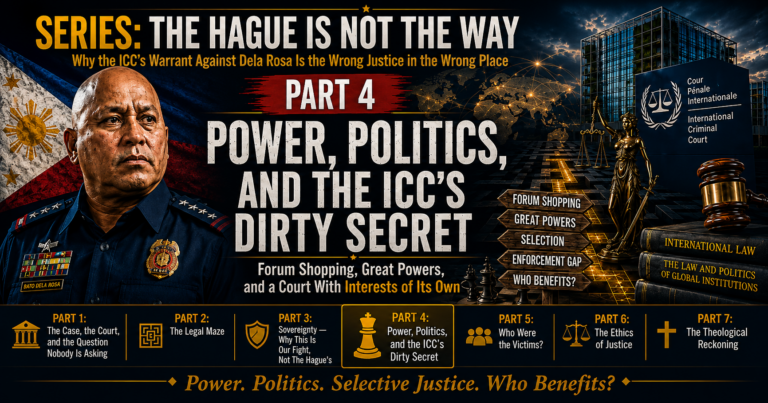
Suppose we grant the ICC every legal point it claims for itself. Harder questions remain. Is it a neutral referee standing above politics, or a political actor with interests of its own? Why did its first fourteen years of investigations all land on one continent? Why do warrants against the powerful gather dust while the machinery worked flawlessly in Manila? And why did cooperation arrive at the exact moment the court’s targets became the administration’s rivals? Part 4 puts the court itself on trial, using political science. The full scholarly paper behind this seven part series, with complete citations and academic analysis, is available for download at the end of this post. A companion podcast episode is also available there for those who prefer listening over reading.
The Hague Is Not The Way, Part 1: The Case, the Court, and the Question Nobody Is Asking
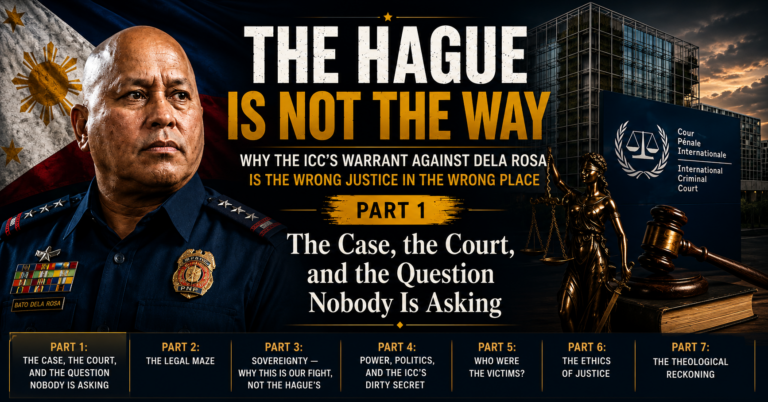
The ICC issued an arrest warrant against Senator Ronald “Bato” Dela Rosa. Everyone has an opinion. Very few have a framework. Before we debate guilt or innocence, we need to ask the question nobody is asking: is the ICC even the right court? This series breaks down a 62-page scholarly paper into plain, accessible language that any reader can follow. For those who want the full academic treatment, the complete paper with all citations, legal analysis, and theoretical frameworks is available for free download at the end of each post. This is Part 1 of 7 of a multidisciplinary, cross-disciplinary, and normative transdisciplinary scholarly series examining the case through nine academic lenses integrated through a theological meta-framework. The answer may surprise you.