
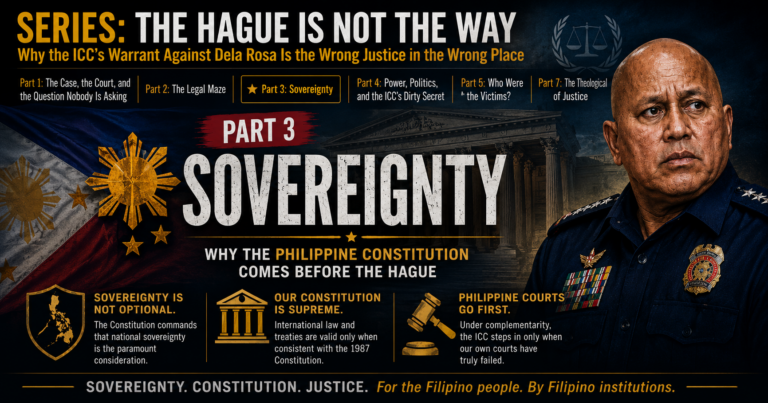
The Philippines has its own Constitution, its own courts, and its own laws that cover exactly the kind of crimes being talked about in the Dela Rosa case. So why is a Filipino senator being taken to a court in the Hague Netherlands? This post breaks it down in plain language: what the Philippine Constitution actually says about outside courts having power over Filipino citizens, why the ICC was never supposed to be the first stop for justice, how the collapse of the Marcos and Duterte alliance changed the political picture entirely, and why the law most people think proves the ICC’s case actually does the opposite. No legal background needed. And if you want the full deep dive with complete legal citations and academic analysis, the FULL scholarly paper that is the basis for the entire seven part blogpost is available for download at the end of this post.
The Hague Is Not The Way, Part 2: The Legal Maze
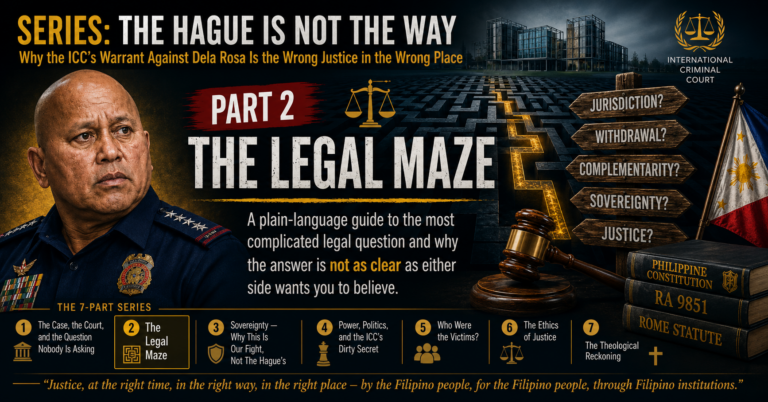
Did the ICC even have the legal authority to issue a warrant against Bato Dela Rosa in the first place? The government moved to arrest him. The media called it justice. But that question, the most important legal question in this entire controversy is one that even some of the ICC’s own judges could not agree on. This post breaks down why, in plain language. We look at what the Rome Statute actually says about countries that leave the ICC, why the Philippines walking out in 2019 created a legal problem that goes all the way to the heart of who we are as a sovereign people, why there are three specific legal arguments that make the Dela Rosa warrant even more legally shaky than the Duterte case, and why the strongest argument in this whole debate is not about politics at all, it is about the sovereignty of our Constitution, the dignity of our courts, and the Filipino people’s own right to decide what justice looks like on their soil. The answer, this post argues, is not a court in the Hague. It never was. For the complete legal and multidisciplinary analysis, download the full scholarly paper linked at the end of this post
The Hague Is Not The Way, Part 1: The Case, the Court, and the Question Nobody Is Asking
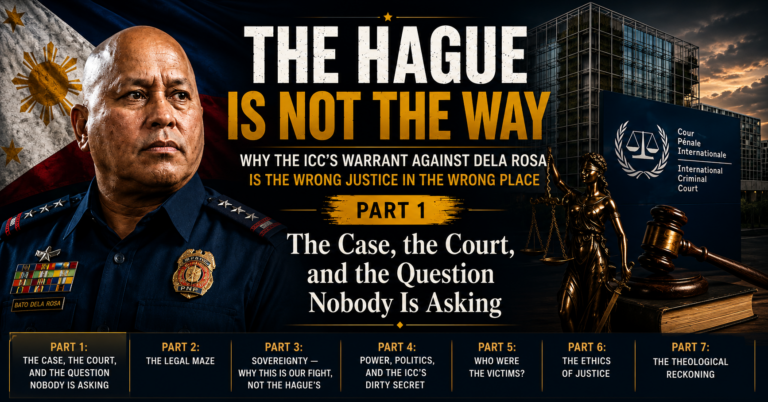
The ICC issued an arrest warrant against Senator Ronald “Bato” Dela Rosa. Everyone has an opinion. Very few have a framework. Before we debate guilt or innocence, we need to ask the question nobody is asking: is the ICC even the right court? This series breaks down a 62-page scholarly paper into plain, accessible language that any reader can follow. For those who want the full academic treatment, the complete paper with all citations, legal analysis, and theoretical frameworks is available for free download at the end of each post. This is Part 1 of 7 of a multidisciplinary, cross-disciplinary, and normative transdisciplinary scholarly series examining the case through nine academic lenses integrated through a theological meta-framework. The answer may surprise you.
Sampling Justice: Mainstream media’s and ICC’s misstep in miscounting misdeeds

Has the International Criminal Court (ICC) appropriately applied statistical methodology in its legal processes regarding the crimes against humanity charges against Duterte?This question arises from a recent Philippine Daily Inquirer (PDI) post, which discusses the ICC’s categorization of 43 cases as “representative examples” amidst a broader investigation into 12,000 to 30,000 deaths (Baclig, 2025). This […]
Art, Myth, and Labubu: Is It Demonic? A Reformed Christian Reflection

I recently came across a video by a pastor on Facebook in which he claims that Labubu is demonic. In his vlog, he presents several arguments and even references Scripture to support his position. You can view the two part video in the links at the end of this article. His argument that Labubu, […]