Life Hacks for Polymaths

Multidisciplinary | Cross-Disciplinary | Interdisciplinary | Transdisciplinary.

  • Facebook
  • Instagram
  • LinkedIn
  • Pinterest
  • YouTube

Welcome, Polymaths!

I’m Zigfred Diaz — polymath, independent scholar, &  lifelong learner integrating multidisciplinary, cross-disciplinary, interdisciplinary & transdisciplinary ideas through a broader theological meta-narrative that serves as my guiding interpretive framework. Feel free to explore.

Powered by Genesis

  • Home
  • About
  • Privacy Policy
  • Archives
  • Categories
    • Book reviews
    • Life Hack for Polymaths
      • Featured Polymaths
      • Life-work Balance
      • Productivity
      • Miscellaneous Ramblings
      • My Life long learnings experiences
    • Business, Entrepreneurship & Leadership
    • Events
    • Financial management & investments
    • Fraud alert
    • Health
    • Hot trends
    • Law, Law Practice, Law Education
    • Making money online, Blogging, SEO
    • Music
    • Politics, Social issues & Current events
    • Reviews
    • Sports
    • Technology
      • Word Press tips
    • Theology, Faith & inspirational
    • Travel and Living
    • Cognitive Archeology
    • Social Work
    • Theology
    • Uncategorized
  • Contact

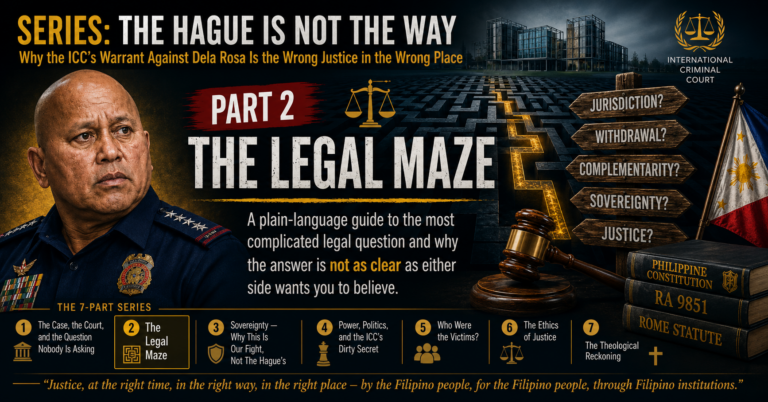
The Hague Is Not The Way, Part 2: The Legal Maze

May 21, 2026 by Zigfred Diaz Leave a Comment

Did the ICC even have the legal authority to issue a warrant against Bato Dela Rosa in the first place? The government moved to arrest him. The media called it justice. But that question, the most important legal question in this entire controversy is one that even some of the ICC’s own judges could not agree on. This post breaks down why, in plain language. We look at what the Rome Statute actually says about countries that leave the ICC, why the Philippines walking out in 2019 created a legal problem that goes all the way to the heart of who we are as a sovereign people, why there are three specific legal arguments that make the Dela Rosa warrant even more legally shaky than the Duterte case, and why the strongest argument in this whole debate is not about politics at all, it is about the sovereignty of our Constitution, the dignity of our courts, and the Filipino people’s own right to decide what justice looks like on their soil. The answer, this post argues, is not a court in the Hague. It never was. For the complete legal and multidisciplinary analysis, download the full scholarly paper linked at the end of this post
Filed Under: Anthropology, Criminology, Cross-disciplinary, Ethics, Hot trends, Interdisciplinary, International Relations, Law, Law Practice, Law Education, Multidisciplinary, Political Science, Sociology, Theological meta-framework, Transdisciplinary Tagged With: Article 127, Article 22 Rome Statute, Asian Journal of International Law, Bato Dela Rosa, Bill of Rights Philippines, command responsibility, common plan doctrine, complementarity principle, Dela Rosa ICC warrant, Dela Rosa warrant, drug war killings, drug war Philippines, due process Philippines, Duterte ICC, expressio unius, forum shopping ICC, ICC accountability, ICC Appeals Chamber, ICC arrest warrant, ICC complementarity, ICC jurisdiction, ICC jurisdiction Philippines, ICC legitimacy, ICC Philippines, ICC temporal jurisdiction, international criminal law, international justice Philippines, Karnavas ICC, Lordkipanidze dissent, LSE Law Review ICC, Marcos ICC, Pangalangan ICC, Pangilinan v Cayetano, People v Tello, Philippine Constitution, Philippine criminal law, Philippine Justice system, Philippine sovereignty, Philippine Supreme Court, Philippine withdrawal ICC, Pre-Trial Chamber ICC, preliminary examination ICC, RA 9851, Republic Act 9851, Rome Statute, Rome Statute withdrawal, Ronald Dela Rosa, sovereignty Philippines, treaty interpretation, withdrawal Article 127