
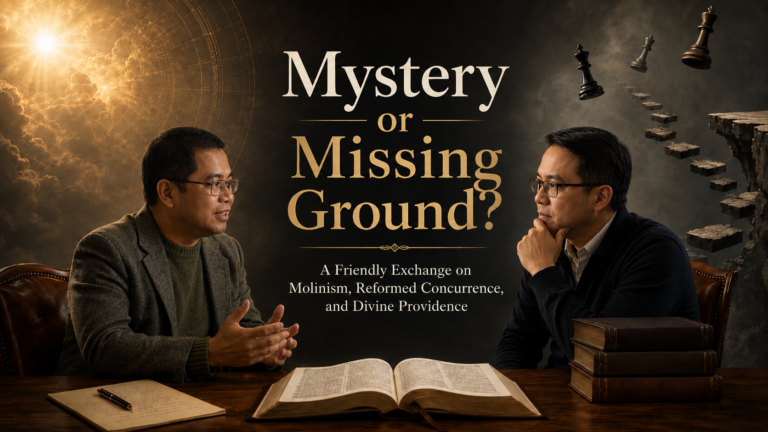
What began as a friendly Facebook exchange with a fellow believer developed into a broader theological and philosophical discussion of Molinism, Reformed concurrence, divine providence, and human freedom. This blog post presents that discussion in clear, accessible language, asking whether Molinism genuinely resolves the tension between God’s comprehensive sovereignty and responsible human agency, or whether it simply relocates the mystery by making God’s decree dependent on counterfactual truths that He neither determines nor grounds. The discussion first examines the grounding objection to middle knowledge and distinguishes the biblical affirmation of God’s counterfactual knowledge from the additional philosophical claims distinctive of Molinism. It then turns to a new meta-theological framework, Theoikophysignosis, which provides a method for evaluating the competing positions and for developing a constructive account of Reformed concurrence. The central question is whether Calvinism faces an acknowledged mystery whose mechanism remains underspecified (until lately), while Molinism rests upon the more foundational problem of missing ground. A full scholarly essay is available for download at the end of the post. A companion podcast episode is also available there for those who prefer listening over reading.
Faith, Works, and Salvation: A short Comparative Analysis of Calvin & Arminius’ soteriological perspectives

Question: Explain the relationship between Faith and Works in justification and salvation. Compare the positions of two different theologians: John Calvin and Jacobus Arminius. There is arguably no better demonstration of the relationship between faith and works in justification and salvation than through the soteriological perspectives of John Calvin and Jacobus Arminius. John Calvin, a […]
Debunking KJV Onlyism: Pointing out errors in the “Providential Preservation of the text of the New Testament” chart

Have you seen the chart below? It has been circulating on the internet and across social media for some time now. Many of you may have noticed that a lot of my posts tackle issues related to King James Version (KJV) Onlyism. This issue is particularly close to my heart, as I grew up in […]
The Pitfalls of Using Analogies to Describe the Divine Nature: A Theological Perspective
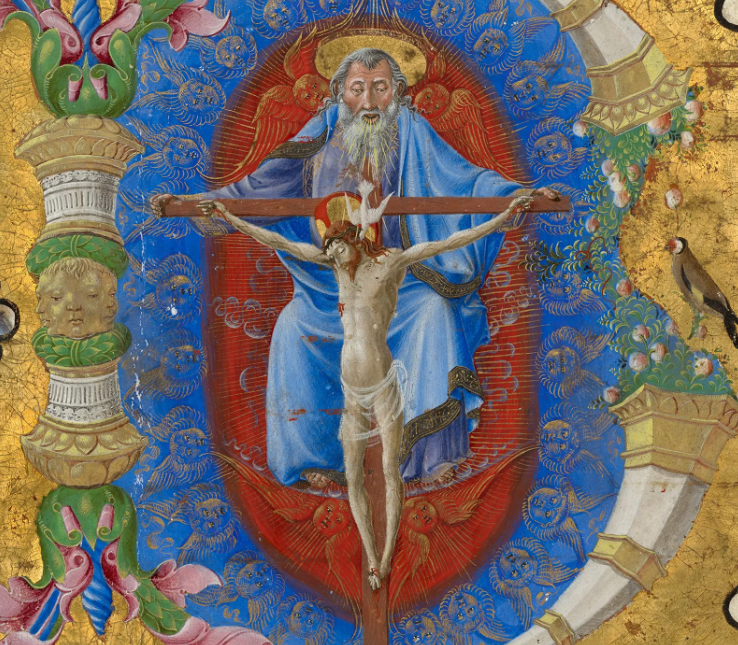
There is probably no other greater theological concept that requires that use of analogical language to describe the divine nature than that of the Trinity. The mysterious truth about the triune nature of God has been fiercely debated upon throughout church history and oftentimes analogies are used in order to somehow try to thresh out […]
Has the Vatican corrupted modern Bible translations?

In the complex landscape of biblical scholarship and translation, the N0vum Testamentum Graece (New Testament in Greek) otherwise popularly known as the Nestle-Aland Greek New Testament (After its after its most influential editors, Eberhard Nestle and Kurt Aland), stands out as a cornerstone for contemporary biblical research and translation. This revered text, now in its […]