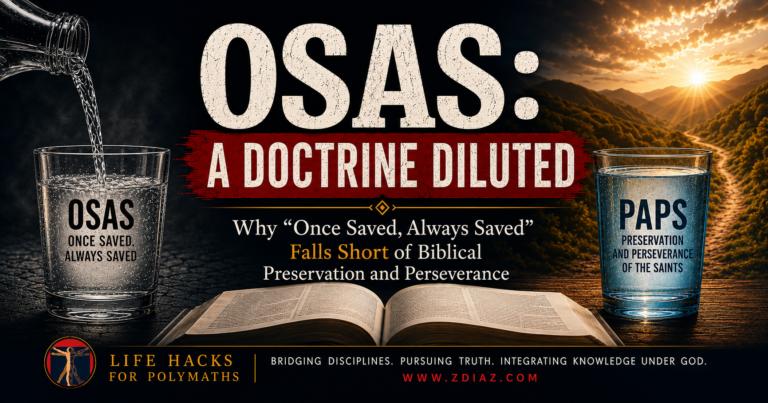
Is “Once Saved, Always Saved” the full biblical doctrine of eternal security or only a diluted version of it? This article argues that OSAS affirms an important truth but often leaves out the equally biblical doctrine of perseverance. Readers will see how Scripture presents salvation as both God’s preservation of his people and their continuing faith in Christ to the end. The article examines key passages in the Scriptures. It also explains how biblical warnings against apostasy function as means God uses to preserve believers rather than as denials of eternal security. Historically, the discussion traces the doctrine from Augustine through the Reformed confessions and shows why OSAS is better understood as a later, thinner abbreviation of the fuller doctrine of the Preservation and Perseverance of the Saints. Readers will discover why true assurance rests not merely in a past profession of faith, but in God’s continuing grace that sustains faith, repentance, holiness, and endurance. The article ultimately argues that those whom God truly saves, he preserves, and those whom he preserves persevere until final glorification. A companion podcast episode is also available there for those who prefer listening over reading.
Mystery or Missing Ground?
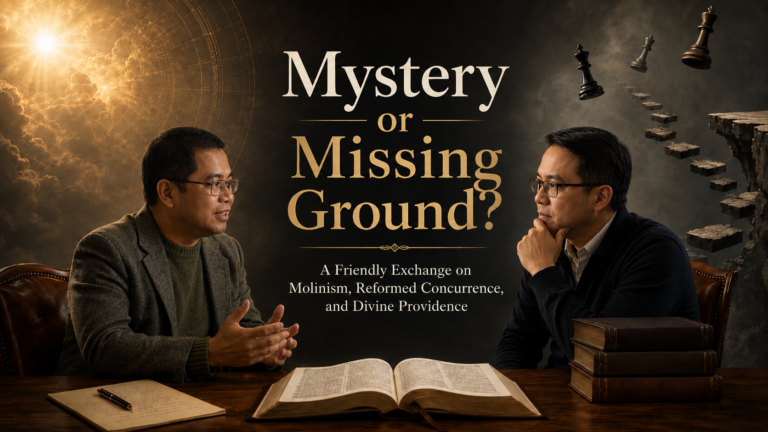
What began as a friendly Facebook exchange with a fellow believer developed into a broader theological and philosophical discussion of Molinism, Reformed concurrence, divine providence, and human freedom. This blog post presents that discussion in clear, accessible language, asking whether Molinism genuinely resolves the tension between God’s comprehensive sovereignty and responsible human agency, or whether it simply relocates the mystery by making God’s decree dependent on counterfactual truths that He neither determines nor grounds. The discussion first examines the grounding objection to middle knowledge and distinguishes the biblical affirmation of God’s counterfactual knowledge from the additional philosophical claims distinctive of Molinism. It then turns to a new meta-theological framework, Theoikophysignosis, which provides a method for evaluating the competing positions and for developing a constructive account of Reformed concurrence. The central question is whether Calvinism faces an acknowledged mystery whose mechanism remains underspecified (until lately), while Molinism rests upon the more foundational problem of missing ground. A full scholarly essay is available for download at the end of the post. A companion podcast episode is also available there for those who prefer listening over reading.
Calvinism and God’s use of “means”

Question: How sure are the Calvinists that they are unconditionally elected if no one shared the gospel to them ? While there are exceptional circumstances in which we hear testimonies of people being “saved” without any direct human involvement in sharing the gospel, God invariably employs means to draw the elect to the saving knowledge […]
Faith, Works, and Salvation: A short Comparative Analysis of Calvin & Arminius’ soteriological perspectives

Question: Explain the relationship between Faith and Works in justification and salvation. Compare the positions of two different theologians: John Calvin and Jacobus Arminius. There is arguably no better demonstration of the relationship between faith and works in justification and salvation than through the soteriological perspectives of John Calvin and Jacobus Arminius. John Calvin, a […]
A Critique of Brian Abasciano’s Corporate Election Theory

Do you agree with Brian Abasciano’s corporate election theory? Why or why not? With regards to corporate election, well of course there is such a thing as corporate election (church, nation) and yes, definitely there is individual election. Even Dr. Abasciano acknowledges this as you quoted above. However I do not subscribe to Dr. Abasciano’s […]