Life Hacks for Polymaths

Multidisciplinary | Cross-Disciplinary | Interdisciplinary | Transdisciplinary.

  • Facebook
  • Instagram
  • LinkedIn
  • Pinterest
  • YouTube

Welcome, Polymaths!

I’m Zigfred Diaz — polymath, independent scholar, &  lifelong learner integrating multidisciplinary, cross-disciplinary, interdisciplinary & transdisciplinary ideas through a broader theological meta-narrative that serves as my guiding interpretive framework. Feel free to explore.

Powered by Genesis

  • Home
  • About
  • Privacy Policy
  • Archives
  • Categories
    • Book reviews
    • Life Hack for Polymaths
      • Featured Polymaths
      • Life-work Balance
      • Productivity
      • Miscellaneous Ramblings
      • My Life long learnings experiences
    • Business, Entrepreneurship & Leadership
    • Events
    • Financial management & investments
    • Fraud alert
    • Health
    • Hot trends
    • Law, Law Practice, Law Education
    • Making money online, Blogging, SEO
    • Music
    • Politics, Social issues & Current events
    • Reviews
    • Sports
    • Technology
      • Word Press tips
    • Theology, Faith & inspirational
    • Travel and Living
    • Cognitive Archeology
    • Social Work
    • Theology
    • Uncategorized
  • Contact

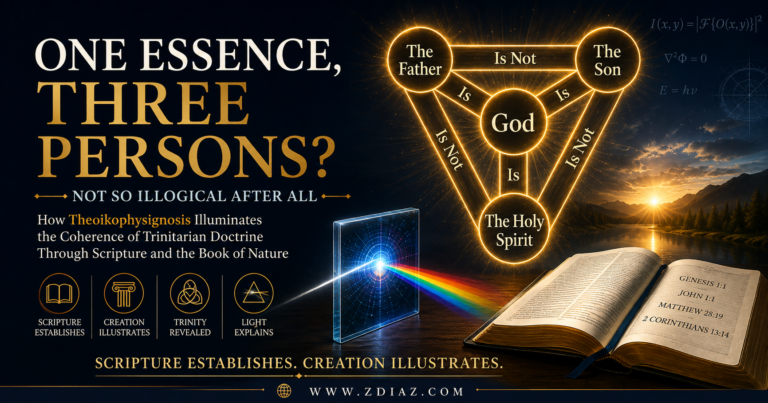
One essence, three persons? Not so illogical afterall

August 9, 2026 by Zigfred Diaz Leave a Comment

One essence, three persons: is the Trinity really a contradiction? This post begins with Scripture, tracing the biblical and original-language foundations of Trinitarian doctrine, before turning to Theoikophysignosis and the physics of light as a carefully limited analogy for understanding how unity and distinction can coexist without logical contradiction. The argument does not attempt to prove the Trinity through science. Scripture establishes the doctrine; creation serves only to illustrate its coherence. The result is a case for moving the discussion from contradiction to mystery. A full scholarly essay is available for download at the end of the post. A companion podcast episode is also available there for those who prefer listening over reading.

Filed Under: Apologetics, Cross-disciplinary, Hot trends, Interdisciplinary, Multidisciplinary, My Life long learnings experiences, Theological meta-framework, Theology, Faith & inspirational, Transdisciplinary Tagged With: 1 Corinthians 8:6, Arianism, Biblical Greek, Biblical Hebrew, Biblical Theology, Book of Nature, Celestial Holography, Christian apologetics, Christian doctrine, Christian Philosophy, Christian Theology, Deity of Christ, Divine Mystery, Doctrine of God, Father Son Holy Spirit, General Revelation, Genesis 1, Holographic Principle, Holography, Holy Spirit, interdisciplinary theology, John 1:1, John 10:30, Matthew 28:19, Modalism, Monotheism, Nicene Creed, One Essence Three Persons, Oneness, Oneness heresy, Oneness Theology, Physics and Theology, Reformed theology, Science and Faith, Scripture and Science, Special Revelation, Systematic Theology, Theoikophysignosis, Theology and Science, Trinitarian Doctrine, Trinity, Trinity Analogy, Trinity and Science, Tritheism

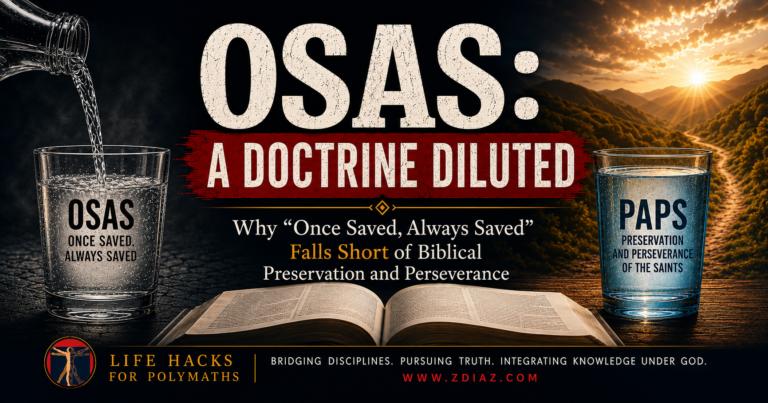
OSAS: A Doctrine Diluted

July 27, 2026 by Zigfred Diaz 2 Comments

Is “Once Saved, Always Saved” the full biblical doctrine of eternal security or only a diluted version of it? This article argues that OSAS affirms an important truth but often leaves out the equally biblical doctrine of perseverance. Readers will see how Scripture presents salvation as both God’s preservation of his people and their continuing faith in Christ to the end. The article examines key passages in the Scriptures. It also explains how biblical warnings against apostasy function as means God uses to preserve believers rather than as denials of eternal security. Historically, the discussion traces the doctrine from Augustine through the Reformed confessions and shows why OSAS is better understood as a later, thinner abbreviation of the fuller doctrine of the Preservation and Perseverance of the Saints. Readers will discover why true assurance rests not merely in a past profession of faith, but in God’s continuing grace that sustains faith, repentance, holiness, and endurance. The article ultimately argues that those whom God truly saves, he preserves, and those whom he preserves persevere until final glorification. A companion podcast episode is also available there for those who prefer listening over reading.

Filed Under: Apologetics, Calvinism, Polemics, Soteriological issues, Theology, Faith & inspirational Tagged With: 1 John 2:19, 1 Peter 1:5, apostasy, assurance of salvation, Augustine, Biblical Theology, Calvinism, Canons of Dort, Christian doctrine, divine preservation, doctrine of salvation, eternal security, exegetical theology, Free Grace theology, historical theology, historico-theological analysis, John 10, Once Saved Always Saved, OSAS, PAPS, perseverance, perseverance of the saints, preservation and perseverance, preservation of the saints, Reformed theology, sanctification, Saving faith, soteriology, Systematic Theology, Westminster Confession

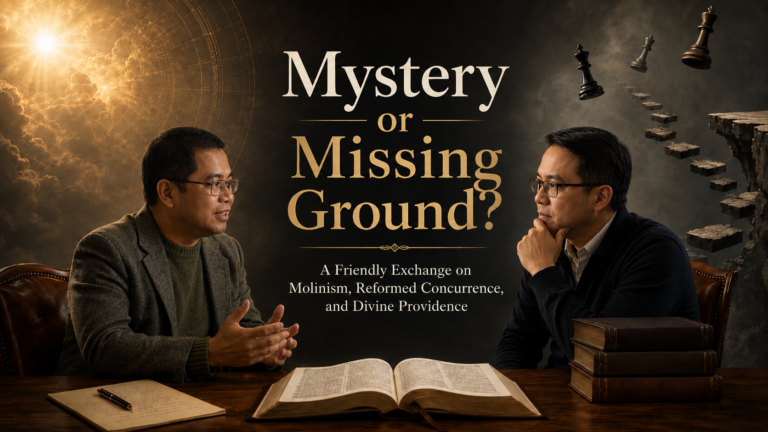
Mystery or Missing Ground?

July 18, 2026 by Zigfred Diaz Leave a Comment

What began as a friendly Facebook exchange with a fellow believer developed into a broader theological and philosophical discussion of Molinism, Reformed concurrence, divine providence, and human freedom. This blog post presents that discussion in clear, accessible language, asking whether Molinism genuinely resolves the tension between God’s comprehensive sovereignty and responsible human agency, or whether it simply relocates the mystery by making God’s decree dependent on counterfactual truths that He neither determines nor grounds. The discussion first examines the grounding objection to middle knowledge and distinguishes the biblical affirmation of God’s counterfactual knowledge from the additional philosophical claims distinctive of Molinism. It then turns to a new meta-theological framework, Theoikophysignosis, which provides a method for evaluating the competing positions and for developing a constructive account of Reformed concurrence. The central question is whether Calvinism faces an acknowledged mystery whose mechanism remains underspecified (until lately), while Molinism rests upon the more foundational problem of missing ground. A full scholarly essay is available for download at the end of the post. A companion podcast episode is also available there for those who prefer listening over reading.

Filed Under: Calvinism, Molinism, Soteriological issues, Theology, Theology, Faith & inspirational Tagged With: Aseity of God, Biblical Theology, Calvinism, Christian apologetics, Compatibilism, Counterfactuals of Creaturely Freedom, Divine Providence, Divine Sovereignty, Foreknowledge, Free Will, Friendly Theological Dialogue, God’s Decree, Grounding Objection, Human Freedom, Libertarian Freedom, Middle Knowledge, Molinism, Mystery of Providence, Predestination, Reformed Compatibilism, Reformed Concurrence, Reformed theology, Sovereignty and Responsibility, Systematic Theology, Theoikophysignosis, Theology and Philosophy