
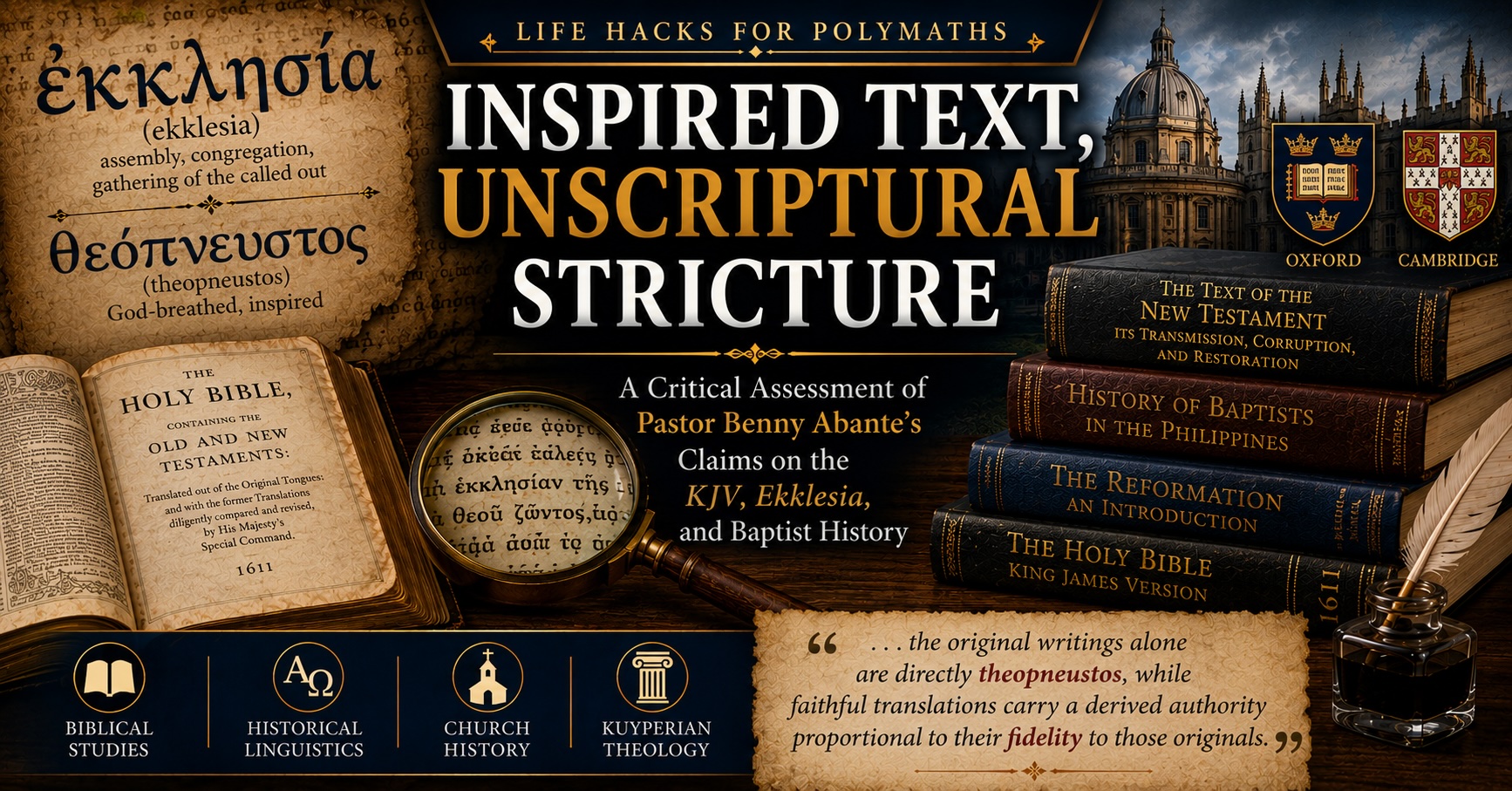
A Critical Assessment of Pastor Bienvenido “Benny” Abante Jr.’s Statements on the King James Version, the Translation of Ekklesia as “Church,” and Baptist Exclusivism
A Transdisciplinary Analysis Integrating Biblical Studies, Historical Linguistics, Translation Theory, Church History, and Kuyperian Public Theology through a Kuyperian Integrative Framework
This blog post is a plain-language, easy-to-read version of a longer scholarly paper. If you prefer a more detailed, fully documented, and academically rigorous treatment of these issues, the complete scholarly paper is available for download at the end of this post. For those who prefer listening rather than reading, a companion Spotify podcast covering what is discussed in the paper is also available near the end of this post.
■ ■ ■
Avideo clip has been circulating recently in social media within Philippine evangelical and Baptist circles, and it has stirred up considerable discussion. In it, Pastor Bienvenido “Benny” Abante Jr., senior pastor of the Metropolitan New Testament Baptist Ekklesia in Manila and a sitting congressman makes several pointed statements about the King James Version of the Bible, the Greek word behind the English word “church,” and a group he calls the “Anabaptists.” The clip went viral especially among independent Baptists and Bible Baptists, many of whom hold the KJV in high regard.
Pastor Abante is not a marginal figure. He leads one of the largest independent Baptist congregations in the Philippines and is a well-known voice in Philippine protestant-evangelical Christianity. When someone of his stature makes claims about biblical history, Greek language, and church tradition from a public platform, those claims deserve careful examination, not out of disrespect, but out of the very commitment to truth that all serious Christians share.
This article does exactly that. It examines what Pastor Abante said, evaluates it honestly, and organizes the findings into three categories: what he got wrong, what he got partially right, and what he got right. The goal is not to attack him as a person. The goal is to think carefully about important questions that affect how Filipino Christians understand their Bible.
■ ■ ■
What Did Pastor Abante Actually Say?
Here is a summary of the key claims he made, delivered in a mix of English and Filipino during a conference in Cebu City in June 2026:
“They were not all saved [referring to the KJV translators]. They were linguists. They were experts in Greek and Hebrew but not all of them were saved. They didn’t come from Baptist churches – they came from the Anglican Church. They studied at Oxford, they studied at Cambridge. There was no Baptist translator. Those who believe the King James is inspired – that is a cult. That is Anabaptist… The Anabaptists believe that if you do not use the King James when you witness, the person cannot be saved… [The word] ‘church’ should not be there – it should be ‘Ekklesia’ – because the word church in Greek is ‘Kyriakos.'”
– Pastor Bienvenido Abante Jr., Cebu City conference, June 2026 (translated and paraphrased from mixed English-Filipino, His exact words extracted from the viral video clip and quoted in the full scholarly paper that you can download at the end of the post. Note however that the clip from where his quote is extracted from is nowhere to be found in social media now. Most likely it must have been take down for yet unknown reasons)
Let us now go through these claims one by one.
■ ■ ■
What He Got Wrong
1. “The KJV Translators Were Not Saved” – An Unwarranted Judgment
Pastor Abante says, in Filipino, “hindi saved ang mga iyan” – “those men were not saved.” This is a very serious and sweeping claim. And here is the problem: no human being can make that judgment about another person’s eternal state.
The Bible itself is clear on this. In 1 Samuel 16:7, God tells Samuel: “Man looks at the outward appearance, but the LORD looks at the heart.” In 2 Timothy 2:19, Paul writes: “The Lord knows those who are his.” These passages remind us that the question of who is truly saved belongs ultimately to God alone, not to us, and certainly not to anyone looking back four centuries later.
Concept Explained: The Hasty Generalization Fallacy
A hasty generalization is a logical error where someone draws a broad conclusion from too little evidence. Instead of examining each translator individually, Pastor Abante appears to assume that because the translators were Anglican (members of the Church of England), they were “not all saved.”
Many of the KJV translators left behind writings that show deep personal faith, a firm commitment to the Scriptures, and sincere belief in the core doctrines of Christianity. Were they all certainly born again in the evangelical sense? We cannot know for certain. That is precisely the point and it is a point that requires humility, not a sweeping verdict.
The burden of proof falls on the person making the accusation. Without concrete historical evidence that specific translators were personally unregenerate, this claim remains speculation, and speculation about someone’s eternal soul is a very serious matter. The appropriate Christian posture here is humility, not condemnation.
2. The Anabaptists and the KJV – A Major Historical Error
Pastor Abante labels those who believe in the KJV’s exclusive authority as “Anabaptist” and says the Anabaptists teach that people cannot be saved unless the KJV is used when sharing the gospel. This contains a significant historical error.
Here is the basic timeline that makes the problem clear: The Anabaptist movement began in 1525 in Zurich, Switzerland led by men like Conrad Grebel, Felix Manz, and Georg Blaurock. The King James Bible was not published until 1611. That is an 86-year gap. The original Anabaptists could not possibly have built their identity around a Bible that did not yet exist.
Who Were the Historical Anabaptists?
The Anabaptists were a radical wing of the Protestant Reformation in the 1500s. They are known for four core convictions:
- Believer’s baptism – they rejected infant baptism, insisting that baptism is only for those who have personally confessed faith in Christ (this is where the name “Ana-baptist,” meaning “re-baptizer,” came from)
- Nonviolence and pacifism
- Separation of church and state
- Radical discipleship and community
Their descendants today include the Mennonites, the Amish, and the Hutterites. None of these groups are associated with KJV-exclusivism. The “KJV-Only” position is a 20th-century American fundamentalist movement associated with figures like Peter Ruckman among others and has no meaningful connection to the 16th-century Anabaptists.
Now, to be fair to Pastor Abante, it appears that he may be referring to a specific contemporary group in the Philippines, not the historical Anabaptists. There is indeed a group operating in the Visayas that calls itself Anabaptist, was founded by a pastor who came from the independent Baptist tradition, and holds a very strong commitment to the KJV 1611. This group holds annual KJV 1611 conferences and even rejects the “King James Cebuano,” a Cebuano-language adaptation that follows the KJV structure. Their textual exclusivism appears to go further than most KJV-Only groups in the West.
However, whether this group actually teaches that people cannot be saved unless the KJV is used is a specific claim that requires verification from the group’s own published materials. That particular assertion by Pastor Abante remains unconfirmed at the time of writing.
The bottom line: even if this local Philippine group holds extreme KJV positions, calling them “Anabaptist” in the historical sense is inaccurate. It misleads people about both the contemporary group and the rich, complex history of actual Anabaptism.
3. “The Greek Word for Church is Kyriakos” – A Factual Error
Pastor Abante states: “The word church in the Greek is ‘Kyriakos.'” This is factually incorrect as a description of how the New Testament uses the Greek language.
Two Greek Words You Need to Know
Ekklesia (ἐκκλησία) – This is the Greek word the New Testament actually uses for the Christian congregation. It appears 114 times in the New Testament. It means “assembly” or “called-out gathering.” When Jesus says “I will build my church” in Matthew 16:18, the word is ekklesia.
Kyriakos (κυριακός) – This Greek word means “belonging to the Lord” or “of the Lord.” It appears only twice in the entire New Testament: in 1 Corinthians 11:20 (“the Lord’s supper”) and Revelation 1:10 (“the Lord’s day”). It is never used in the New Testament to mean the Christian assembly.
So when Abante says “the word church in Greek is kyriakos” that is simply not how the New Testament uses these words. Ekklesia is the New Testament word for the church. Kyriakos is used for things belonging to the Lord, not for the gathered congregation.
However, and this is where Abante is onto something real, the English word “church” does trace its etymology back to kyriakos, not ekklesia. That part he gets right, and we will discuss it in the next section.
■ ■ ■
An Important Side Discussion: Is the KJV Inspired?
Pastor Abante’s statements raise a related question worth addressing clearly: what does it mean for a Bible to be “inspired,” and does that apply to the KJV?
Concept Explained: Theopneustos and the Autographa
In 2 Timothy 3:16, Paul writes: “All Scripture is God-breathed.” The Greek word is theopneustos (θεόπνευστος) literally, “breathed out by God.”
Christian theologians have consistently understood this to apply to the autographa, the original manuscripts written by the biblical authors themselves (Moses, Isaiah, Paul, John, and so on). These original writings, in Hebrew, Aramaic, and Greek, are what God directly “breathed out.”
A translation like the KJV is not itself directly “breathed out” by God in this technical sense. But this does not mean a translation has no authority. When a translation accurately and faithfully conveys what the original texts say, it carries the same message God breathed out, like a trustworthy copy or a faithful photograph of an original painting. The authority is derived from the original, not added fresh.
You do not have to choose between saying “the original manuscripts are inspired” and “the KJV is a trustworthy and authoritative Bible.” Both can be true at the same time as long as we are precise about what we mean.
The KJV itself is honest about this. Its title page says it was “translated out of the original tongues” and “diligently compared and revised.” It does not claim to be directly inspired in the same way the original manuscripts were. That is not a weakness, it is an accurate and humble self-description.
■ ■ ■
What He Got Partially Right
1. The KJV Translators Were Indeed Mostly Anglican
This is historically accurate. The approximately 47 scholars commissioned by King James I in 1604 were predominantly members of the Church of England. They worked in six groups at Westminster, Oxford, and Cambridg, the academic heartland of the Anglican establishment. Very few, if any, came from separatist or Baptist backgrounds. Abante is right about this historical fact.
Where it becomes “partially right” rather than fully right is in what he implies from this fact, namely that their Anglican background means they were unsaved, or that it compromised the translation. That conclusion does not follow. Being Anglican does not automatically mean one lacks genuine faith, and the quality of the translation is measured by how faithfully it renders the original Hebrew and Greek, not by the denominational membership of the translators.
2. The English Word “Church” Does Not Come from Ekklesia
Here is where Abante makes a genuinely interesting observation, even if he draws the wrong conclusion from it.
He is correct that the English word “church” does not descend from ekklesia. It traces back to the Greek word kyriakon (meaning “the Lord’s house”), which passed through early Germanic languages, becoming kirika in Proto-Germanic, cirice in Old English, chirche in Middle English, and finally “church” in Modern English. Meanwhile, the Spanish word iglesia, the French église, and the Italian chiesa all come from ekklesia through Latin ecclesia. English took a different etymological path than the Romance languages.
Concept Explained: The Etymological Fallacy
The etymological fallacy is the mistake of thinking that a word’s current meaning must be determined by its historical origin. Here is a simple example: the English word “salary” comes from the Latin salarium, which relates to salt because Roman soldiers were sometimes paid in salt. But nobody today thinks “salary” means salt. The word moved on. Its meaning today is determined by how people use it today, not by where it came from.
The same principle applies to “church.” Yes, its etymology traces back to kyriakon rather than ekklesia. But for over a thousand years, English-speaking Christians have used “church” to mean exactly what ekklesia means in the New Testament: the local congregation, the gathered community of believers, the body of Christ. The word does the job. The etymology does not disqualify it.
In translation theory, this is called functional equivalence: what matters is not whether the English word and the Greek word share the same historical roots, but whether they communicate the same meaning. “Church” communicates what ekklesia meant. That is what makes it a valid translation.
So Abante’s etymological observation is interesting and worth knowing. But his conclusion, that the KJV translators were therefore wrong, or that they used “church” to please the Anglicans and Roman Catholics is not supported by the evidence. “Church” was simply the standard English word for the Christian assembly in 1611. There was no other commonly understood English equivalent available.
3. The New Testament Did Distinguish Ekklesia from the Jewish Synagoge
Abante is also right that the New Testament writers appear to have used ekklesia deliberately to distinguish the Christian gathering from the Jewish synagoge (synagogue). His point about Ezra being associated with the beginnings of the synagogue tradition during the post-exile period is also broadly supported by historical scholarship. These are real and substantive observations about biblical ecclesiology, even if the linguistic argument around them is flawed.
■ ■ ■
What He Got Right
1. The KJV’s Title Page Does Not Claim to Be Inspired
This is a genuinely correct observation and an important one. Pastor Abante points out that if you open a King James Bible and look at the title page, it does not say “inspired.” What it says is that this is the Bible “translated out of the original tongues, and with the former translations diligently compared and revised, by his majesty’s special command.” That is a description of a careful human translation process, not a claim of direct divine inspiration.
Some in the KJV-Only movement go so far as to claim that the KJV is itself divinely re-inspired, superior even to the original Greek and Hebrew manuscripts. That is a theological position the mainstream KJV itself does not make and that mainstream evangelical Christianity has consistently rejected. Abante is right to push back on that extreme claim.
2. Making the KJV a Requirement for Salvation Is Theologically Indefensible
If any group truly teaches that a person cannot be saved unless the KJV is used when sharing the gospel, that position is wrong and Abante is right to oppose it. Salvation originates in God’s eternal election, is accomplished through the person and work of Jesus Christ, applied by the Holy Spirit, received through faith alone, and ordinarily communicated through the preaching of the gospel. The language or translation of the Bible used in the process is a vehicle for that message, not a condition of the message itself.
The Bible translation movement such as Wycliffe, SIL, and thousands of missionaries across history has been built on the conviction that God’s Word can and should be communicated in every language and translation to every people. To attach the KJV as a soteriological requirement is to add a condition to the gospel that Scripture does not impose.
■ ■ ■
Conclusion: A Scorecard
Here is a quick summary of what the analysis found:
| Claim | Verdict |
|---|---|
| The KJV translators “were not saved” | Wrong – unwarranted judgment; only God knows |
| KJV exclusivism = Anabaptism (historical) | Wrong – historically impossible; 86-year gap |
| “The Greek word for church is kyriakos“ | Wrong – it is ekklesia, not kyriakos |
| The translators were mostly Anglican, not Baptist | Right |
| “Church” comes from kyriakos, not ekklesia | Partially Right – etymologically true, but not a mistranslation |
| KJV’s title page doesn’t claim inspiration | Right |
| KJV as salvation requirement is theologically wrong | Right |
Pastor Abante clearly has a heart for getting the gospel right and protecting people from unhealthy extremism around Bible translations. That pastoral concern is commendable. But some of the claims he made in pursuit of that goal, particularly the judgment about the translators’ salvation and the misidentification of the historical Anabaptist tradition are factually incorrect and require correction.
The Kuyperian tradition that underlies all the scholarly work on this site holds that honoring God means honoring truth in every domain, including history, linguistics, and theology. Public figures, whether in politics or in ministry, bear a heightened responsibility for accuracy when they speak to large audiences. That is not a criticism of Pastor Abante’s sincerity. It is a reminder that all of us who teach and preach are called to handle the Word of God, and the facts of history with care.
■ ■ ■
Theological Meta-Framework: Synthesis and Integrating Perspective
From the perspective of Kuyperian Reformed public theology, every sphere of human life and inquiry, including language, history, and biblical scholarship, falls under the Lordship of Jesus Christ. Abraham Kuyper’s famous declaration that “there is not a square inch in the whole domain of human existence over which Christ does not say ‘Mine'” applies as much to Greek lexicons and church history textbooks as to courts and parliaments.
This has two practical implications for the issues raised in this article. First, the doctrine of common grace, the teaching that God in his sovereign providence grants knowledge, skill, and competence even to those who may not be in saving relationship with him, directly addresses Abante’s concern about the translators. Even granting for the sake of argument that some or all of the KJV translators were not genuinely regenerate, this would not disqualify their work. God is not dependent on the spiritual credentials of his instruments. He has worked through imperfect, flawed, and even unbelieving human beings throughout redemptive history to accomplish his purposes. The translators’ mastery of Greek and Hebrew, their painstaking fidelity to the original texts, and the remarkable accuracy of their work are not negated by questions about their personal salvation. God’s providence in preserving and transmitting his Word is simply not limited by denominational membership cards.
Second, sphere sovereignty – Kuyper’s teaching that each domain of human life has its own God-given integrity and standards means that when a pastor steps into the domain of biblical scholarship, historical linguistics, or church history, the standards of those disciplines apply. Pastoral authority is genuine within its proper sphere, but it does not override the requirements of historical accuracy or linguistic precision. Truth in every sphere is God’s truth, and getting it right is an act of worship.
This paper ultimately calls for something very simple: epistemic humility, the willingness to acknowledge the limits of what we can know, especially when making judgments about other people’s eternal state. That humility is not weakness. It is wisdom, and it is deeply Scriptural.
Full Scholarly Paper
Inspired Text, Unscriptural Stricture: A Critical Assessment of Pastor Bienvenido Abante Jr.’s Statements on the King James Version, the Translation of Ekklesia as “Church,” and Baptist Exclusivism
This blog post is the accessible, plain-language version of a longer and more technical scholarly paper. If you want the deeper analysis with full theoretical grounding, expanded historical documentation, linguistic analysis, and academic references, the complete paper is available for download.
Listen to the Companion Podcast
The Deep Dive, Episode 1: Inspired Text, Unscriptural Stricture
Prefer to listen instead of read? This episode walks through the same analysis in conversational form. Listen below on Spotify.
Don’t have Spotify yet? It’s free to download on iOS, Android, and desktop. While you’re there, hit Follow on zdiaz.com | Life Hacks for Polymaths: The Deep Dive so new episodes land in your library automatically.
References
Barr, J. (1961). The semantics of biblical language. Oxford University Press.
Barnhart, R. K. (Ed.). (1988). Chambers dictionary of etymology. Chambers.
Crystal, D. (2010). The Cambridge encyclopedia of the English language (3rd ed.). Cambridge University Press.
Estep, W. R. (1996). The Anabaptist story: An introduction to sixteenth-century Anabaptism (3rd ed.). Eerdmans.
Fee, G. D., & Stuart, D. (2014). How to read the Bible for all its worth (4th ed.). Zondervan.
Gehring, R. W. (2004). House church and mission: The importance of household structures in early Christianity. Hendrickson.
Grudem, W. (1994). Systematic theology: An introduction to biblical doctrine. Zondervan.
Kuyper, A. (1998). Abraham Kuyper: A centennial reader (J. D. Bratt, Ed.). Eerdmans. (Original work published 1898, 1902)
Levine, L. I. (2000). The ancient synagogue: The first thousand years. Yale University Press.
Mounce, W. D. (2006). Mounce’s complete expository dictionary of Old and New Testament words. Zondervan.
Nicolson, A. (2003). God’s secretaries: The making of the King James Bible. HarperCollins.
Nida, E. A., & Taber, C. R. (1969). The theory and practice of translation. Brill.
Norton, D. (2011). The King James Bible: A short history from Tyndale to today. Cambridge University Press.
Saussure, F. de. (1983). Course in general linguistics (R. Harris, Trans.). Open Court. (Original work published 1916)
Warfield, B. B. (1948). The inspiration and authority of the Bible (S. G. Craig, Ed.). Presbyterian and Reformed Publishing.
White, J. R. (1995). The King James Only controversy: Can you trust modern translations? Bethany House.
Williams, G. H. (1992). The radical Reformation (3rd ed.). Sixteenth Century Journal Publishers.
Wolterstorff, N. (1997). Abraham Kuyper. In P. Marshall, S. Griffioen, & R. Mouw (Eds.), Stained glass: Worldviews and social science (pp. 60-72). University Press of America.

Leave a Reply