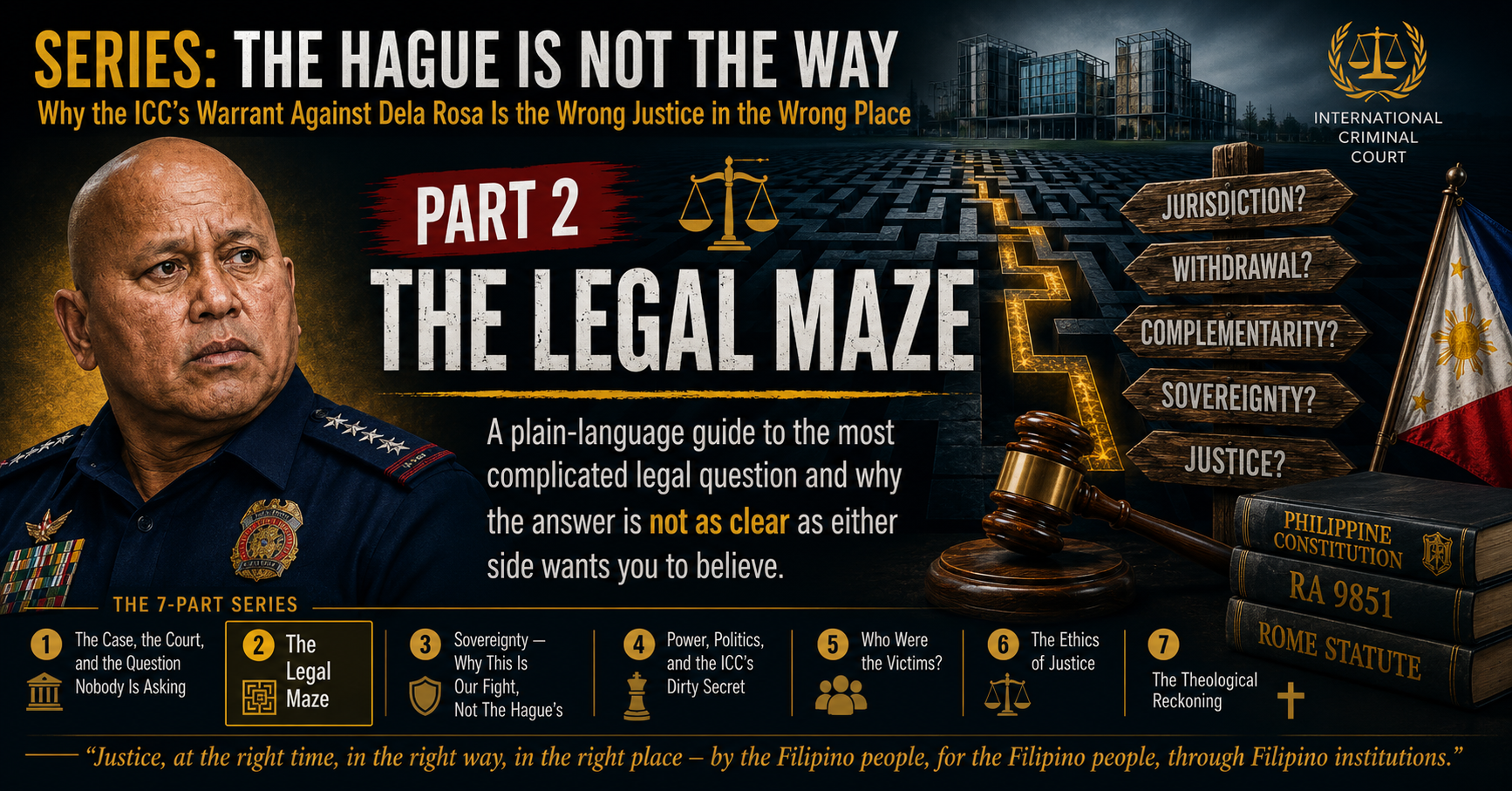
Series: The Hague Is Not The Way
Why the ICC’s Warrant Against Dela Rosa Is the Wrong Justice in the Wrong Place
Part 1: The Case, the Court, and the Question Nobody Is Asking |
Part 2: The Legal Maze ✦ |
Part 3: Sovereignty, Why This Is Our Fight, Not The Hague’s |
Part 4: Power, Politics, and the ICC’s Dirty Secret |
Part 5: Who Were the Victims? |
Part 6: The Ethics of Justice |
Part 7: The Theological Reckoning
This blog post is a plain-language, easy-to-read version of a longer scholarly paper. If you prefer a more detailed, fully documented, and academically rigorous treatment of these issues, the complete scholarly paper is available for download at the end of this post. For those who prefer listening rather than reading, a companion Spotify podcast covering the entire series is also available near the end of this post.
A plain-language guide to the most complicated legal question in Philippine jurisprudence right now, and why the answer is not as clear as either side wants you to believe.
There is a question sitting at the center of the Dela Rosa ICC case that almost nobody in the Philippine media is actually asking. Not whether the alleged killings were wrong. Not whether Bato Dela Rosa deserves to be investigated. Not even whether he is guilty. The question is much more specific and much more important than any of that.
The question is: Did the ICC actually have the legal authority to issue this warrant in the first place?
You might assume that question is already settled. After all, two ICC chambers said yes. But here is what you probably did not hear: the ICC’s own judges could not fully agree on the answer. Back in 2023, the ICC’s Appeals Chamber voted on whether to allow the Philippines investigation to continue. Two out of five judges said no, arguing that the ICC had lost its authority over the Philippines once the country walked out. That was a 3 to 2 vote, and it was the first sign that something legally important was being contested inside the court itself (ICC, 2023). Then in 2026, when the question came up again in the Duterte case, one judge dissented again, this time in a 4 to 1 vote (ICC, 2026b; ICC, 2026c). That dissenting judge did not write a short note of disagreement. He wrote a detailed, five-page legal argument explaining exactly why he thought the majority got it wrong.
This post breaks all of it down in plain language. It explains how the ICC gets its authority, why the Philippines leaving the ICC in 2019 created a real legal problem, what three specific arguments make the case against Dela Rosa even more legally shaky than the case against Duterte, and why a Philippine law called Republic Act 9851, when you read it properly alongside the Philippine Constitution and even the Rome Statute itself, actually points toward Philippine courts as the right place to handle all of this, not a court in the Hague, Netherlands.
Let us start from the very beginning.
■ ■ ■
Understanding the Basics · How the ICC Gets Its Power
The Rome Statute: A Treaty That Created a Court
The International Criminal Court was created in 2002 through a treaty called the Rome Statute (1998). Think of a treaty like a contract between countries. When a country signs and ratifies the treaty, it is basically agreeing to a set of rules, including allowing the ICC to step in and prosecute certain crimes if needed. The Philippines signed up in 2011 (Pangilinan v. Cayetano, 2021).
The ICC does not handle ordinary crimes. It only deals with the most serious ones: genocide, crimes against humanity, war crimes, and the crime of aggression. And even then, it can only get involved when a country genuinely cannot or will not handle the case on its own. That rule is called the complementarity principle (Rome Statute, 1998, Art. 17). The ICC is meant to be the very last option, not the first one.
The treaty also allows countries to leave. Article 127 of the Rome Statute says any country can withdraw by sending a written notice and waiting one year. The Philippines did exactly this in March 2018, and officially left on March 17, 2019. The big question the law has to answer is: what happens to crimes that were allegedly committed while the Philippines was still a member?
The Timeline Everything Depends On
To really understand what is being argued, you need to know the order in which things happened. The dates are not just background details. They are the actual substance of the legal debate.
| When | What Happened | Why It Matters Legally |
|---|---|---|
| 2011 | Philippines ratifies the Rome Statute (1998) | The Philippines officially joins the ICC. From this point on, the ICC has authority over crimes committed in the country. |
| Jul 2016 to Apr 2018 | Drug war killings occur. Dela Rosa serves as PNP Chief. | The Philippines is still a member at this point. Dela Rosa’s time as PNP Chief ends in April 2018. That date is legally very important as we will see later. |
| Feb 8, 2018 | The ICC Prosecutor opens a Preliminary Examination (ICC, 2021a). | Think of this as the ICC’s version of initial fact-finding. The Prosecutor’s office starts looking into the situation. No judges are involved yet. No charges. No suspects named. Just a preliminary look. |
| Mar 17, 2018 | Philippines sends its withdrawal notice. | The one-year countdown to exit begins. Dela Rosa still has one month left as PNP Chief when this happens. |
| Mar 17, 2019 | The Philippines officially exits the ICC. | The Philippines is no longer a member. The Prosecutor is still doing its preliminary look, but no judge has been asked to do anything yet. |
| May 24, 2021 | The Prosecutor finally asks the judges to open a formal investigation, more than two full years after the Philippines left (ICC, 2021a). | This delay is a big deal. The Prosecutor had a full year after the withdrawal notice was filed to ask judges to authorize an investigation. That window was not used. |
| Sep 15, 2021 | ICC judges formally authorize the investigation (ICC, 2021a). | This is the first time actual judges formally get involved, more than three years after Dela Rosa left the PNP. |
| Jan 26, 2023 | The Marcos administration appeals the ICC’s complementarity ruling while still officially resisting ICC involvement (ICC, 2023). | The government’s position is confusing at this stage, resisting the ICC while seemingly engaging it. This political back-and-forth matters a lot in Part 4. |
| Jul 18, 2023 | The ICC Appeals Chamber votes to allow the investigation to continue, but only 3 to 2. Two judges vote against, arguing the ICC may no longer have authority over the Philippines (ICC, 2023). | This is the first big crack in the ICC’s legal foundation. Two out of five judges on the highest ICC chamber say the court may have overstepped. This is not a minor footnote. This is the ICC’s own judges publicly disagreeing about whether the court has the right to be involved at all. |
| Oct 23, 2025 | ICC Pre-Trial Chamber rules unanimously that it has jurisdiction in the Duterte case (ICC, 2025a). | The first direct jurisdiction ruling in the Duterte case proceedings. But remember, the 2023 split already happened. The debate did not start here. |
| Nov 6, 2025 | The ICC issues an arrest warrant for Dela Rosa, but keeps it secret and under seal (ICC, 2026a). | More than seven and a half years have passed since Dela Rosa left the PNP. The warrant exists but nobody outside the court knows about it yet. |
| Apr 22, 2026 | The ICC Appeals Chamber rules 4 to 1 that it has jurisdiction in the Duterte case. One judge disagrees and writes a detailed dissenting opinion (ICC, 2026b; ICC, 2026c). | Not a clean unanimous ruling. The dissenting judge, writing alone this time, makes essentially the same argument as the two dissenters in 2023: the ICC stretched its authority too far. |
| May 11, 2026 | The Dela Rosa warrant is made public. The NBI tries to arrest him at the Senate. The attempt fails (Al Jazeera, 2026). | The arrest attempt itself had procedural problems, which we discuss below. |
| May 13, 2026 | The Philippine Supreme Court does not grant an immediate TRO but orders the other side to respond (Philstar Life, 2026). | The constitutional question, whether the Bill of Rights was violated by the arrest attempt among other issues is now before the Supreme Court. |
So here is the big picture. The alleged crimes happened while the Philippines was still a member of the ICC. But Dela Rosa left the PNP in April 2018. The ICC’s own judges began formally disagreeing about jurisdiction as early as 2023. The full investigation was only authorized in 2021. The warrant was quietly issued in November 2025 and only made public in May 2026. That is more than seven and a half years from his last alleged act as PNP Chief to the sealed warrant. Those gaps matter enormously in law.
■ ■ ■
Article 127: The Exit Clause and Its Hidden Problem
The Rome Statute’s exit provision is Article 127. It has two parts, and they seem to pull in opposite directions. That tension is at the heart of this entire legal dispute.
The whole legal battle comes down to four words in Article 127(2): “under consideration by the Court.”
Was the Preliminary Examination, which was entirely handled inside the Prosecutor’s office with no judges involved, really a matter “under consideration by the Court”? Or does something only count as being before “the Court” once actual judges are formally involved? The ICC’s first formal judicial involvement came in September 2021, two full years after the Philippines had already left.
That is not a political question. It is a question about what specific words in a treaty actually mean. And the votes inside the ICC itself confirm that this is genuinely contested: 3 to 2 in 2023, 4 to 1 in 2026 (ICC, 2023; ICC, 2026b; ICC, 2026c).
Understanding the Scholarly Argument · The Paper’s Core Legal Challenge
The Paper’s Strongest Legal Argument in Plain Language
The paper is very careful about how it makes this argument. It does not say the ICC obviously and clearly has no authority here. What it says is something more precise and more defensible than that:
“Article 127(2) plausibly imposes temporal and continuity limits on post-withdrawal jurisdictional expansion that the ICC may be interpreting too expansively, and a mere preliminary examination may be insufficient to justify indefinite post-withdrawal prosecution of individuals whose alleged conduct had already concluded before even that examination was announced.”
Diaz, 2026, Section III-A, core scholarly formulation
In everyday language, that means this. The ICC is saying that once the Preliminary Examination started in February 2018, jurisdiction was locked in for everything that might follow, even warrants issued years later against people who were never specifically named during that early examination. The paper argues that is too broad a reading. The treaty says “matters already under consideration,” which logically implies it does not cover matters that were not yet concretely engaged. You cannot preserve something that was not yet actually before the court.
A Legal Principle With a Latin Name, and a Very Simple Idea Behind It
There is a classical legal principle at work here. Its Latin name is expressio unius est exclusio alterius, which sounds complicated but means something very simple: when a law specifically mentions one thing, it implicitly leaves out everything else not mentioned.
Think of it like a will that says “I leave my house to my eldest son.” By specifically naming the eldest son, the law implies the other children do not get the house. The specific mention of one excludes the others not mentioned.
Applied to Article 127(2): by specifically preserving “matters already under consideration,” the treaty implicitly excludes matters that were not yet concretely engaged. A Preliminary Examination that is entirely inside the Prosecutor’s office, with no judges involved and no suspects named, arguably does not qualify as a matter that was already before the court in any meaningful legal sense (Schabas, 2016, pp. 434-440; Bassiouni, 2008, pp. 47-52).
Step by Step: How the Narrower Reading Works
| Step | The Legal Reasoning |
|---|---|
| 1. The treaty protects specific things | Article 127(2) preserves “matters already under consideration,” not every possible future matter connected to a situation |
| 2. Specific mention implies exclusion | That specific protection implicitly leaves out matters that were not yet concretely before the court when the exit happened |
| 3. A preliminary examination is internal only | A Preliminary Examination lives entirely inside the Prosecutor’s office. No judges. No authorization. No suspects named. It has not yet reached “the Court” in any judicial sense (Schabas, 2016, pp. 434-440; Bassiouni, 2008, pp. 47-52) |
| 4. The result | Once a country exits, the Court should not be able to start or substantially expand jurisdiction over matters that were not yet formally and judicially engaged before the exit took effect |
Why Criminal Courts Must Be Extra Careful With Power
There is a deeper reason why this matters beyond just treaty text. Criminal courts hold the most serious power any legal institution possesses: the power to arrest a person, prosecute them, and put them in prison. Because that power is so grave, the law has long required that criminal jurisdiction be read carefully and narrowly, never loosely and expansively. When the law is unclear, courts are supposed to interpret it in favor of the accused person, not in favor of the prosecution. The Rome Statute itself says this in Article 22(2): if there is ambiguity in a criminal provision, it must be interpreted in favor of the accused.
This principle applies to how courts read their own jurisdiction. When jurisdiction is doubtful, you do not expand it by assumption. You apply it cautiously. That is what the dissenting judges were saying. Not that the ICC is wrong. But that when two reasonable readings of the treaty are possible, the one that is more protective of the individual’s rights should be preferred (Diaz, 2026, Section III-A).
The Risk: Making the Exit Door Meaningless
Here is another way to think about this. Imagine you resign from an organization. The organization rules say that anything already being handled when you resign can still proceed. Fair enough. But what if the organization later says: well, we were loosely looking at an issue involving you before you resigned, so we can now formally investigate you, charge you, and take action against you, even though none of that had actually started when you left? That would make the right to resign practically meaningless. You could leave the organization on paper but still be fully subject to its rules indefinitely. That, the paper argues, is exactly what the ICC’s broad reading of Article 127(2) risks doing to the withdrawal right that Article 127(1) explicitly guarantees (Schabas, 2016, p. 430; Bassiouni, 2008, p. 48).
Understanding the Debate · What Each Side Argues
The ICC Majority vs. The Dissenting Judges (2023 and 2026)
The ICC Majority (4 of 5 in 2026, 3 of 5 in 2023)
- A Preliminary Examination is part of the court’s process and counts as being “under consideration.”
- “The Court” in Article 127(2) means the whole institution, including the Prosecutor’s office (ICC, 2026b).
- Reading it the other way would make Article 127(2) useless for early-stage investigations.
- Article 12(2) must be read together with Article 127(2), and together they support continued jurisdiction.
The Dissenting Judges (one in 2026, two in 2023)
- A Preliminary Examination is entirely inside the Prosecutor’s office. No judge has been involved at all. That is not “the Court” (ICC, 2026c).
- “The Court” in legal language means the judicial body, the chambers and the judges, not the prosecution side.
- A matter only comes before the Court when a Pre-Trial Chamber formally authorizes an investigation under Article 15(4). That happened in September 2021, two full years after the Philippines had already left. As the dissenting judge wrote directly: “A preliminary examination is not a matter under consideration by the Court within the meaning of Article 127(2) of the Statute, and a situation is only under consideration by the Court once a pre-trial chamber authorizes an investigation into that situation” (ICC, 2026c).
- Article 127(1) itself already gives a fair solution. The Prosecutor had one full year after the withdrawal notice was filed to ask judges to authorize an investigation. That window was not used. A country that was already doing this correctly was Burundi, which had its judicial authorization secured before withdrawal. In the Philippines, that step was never taken in time (ICC, 2026c; Karnavas, 2025).
An independent ICC defense lawyer based in The Hague named Michael Karnavas reached the same conclusion as the dissenting judges without any connection to the Philippine case: by not acting within the one-year window, the Prosecutor gave up the jurisdictional connection (Karnavas, 2025). Two academic journals, the LSE Law Review (2025) and the Asian Journal of International Law (2025), published scholarly articles reaching similar conclusions. And Professor Raphael Pangalangan of the University of the Philippines called the timing question “the elephant in the courtroom” long before the warrants were issued (Pangalangan, 2023). The full scholarly argument, including the expressio unius principle and the gravest-power doctrine, is explained in the purple box above.
Three Arguments That Apply to Dela Rosa Specifically
On top of everything discussed above, which applies to the Philippines ICC situation generally, the paper identifies three additional arguments that are specific to Dela Rosa personally. These are what make his legal situation even more complicated than Duterte’s. These are not claims that the ICC definitely has no authority. They are serious challenges that the paper argues deserve careful scrutiny, especially in a Philippine court applying Philippine law (Diaz, 2026, Section III-A1).
■ ■ ■
Republic Act 9851: The Most Misread Law in This Debate
Republic Act 9851 is constantly being invoked in debates surrounding the ICC and the Dela Rosa case. The problem is that it is often read in isolation, as though it exists apart from the 1987 Constitution, apart from the Rome Statute’s complementarity framework, and apart from the broader structure of Philippine criminal law. Read in full legal context, the statute tells a far more nuanced story than many commentators suggest.
Understanding the Law in Context
Republic Act No. 9851 (2009) — The Philippine Act on Crimes Against International Humanitarian Law, Genocide, and Other Crimes Against Humanity
In 2009, the Philippines passed its own law that defines and criminalizes the same offenses the ICC handles, including crimes against humanity and genocide. The Philippines did not leave accountability for such offenses entirely to international institutions. It enacted its own law, enforceable by Philippine courts under Philippine sovereignty. This statute stands independently as domestic legislation and does not depend on continued ICC membership in order to operate.
Section 17 says Philippine authorities “may” surrender an accused person to an international court. That word is important. Not “must.” Not “shall.” The law gives the government a choice, not a mandatory instruction. But Section 17 must also be read in full, not selectively quoted. The same provision immediately qualifies that authority with the phrase “pursuant to the applicable extradition laws and treaties” (RA 9851, 2009, Sec. 17). That qualifying clause means the surrender power is not self-executing. Any transfer of custody must still conform to Philippine procedural requirements, constitutional due process, and the treaty framework itself. RA 9851 does not create a blank check for automatic surrender.
This becomes particularly important when read alongside the Rome Statute itself. Article 59(2) of the Rome Statute says a person arrested must be brought promptly before the competent judicial authority in the country where the arrest happens, and that authority must determine whether the warrant applies to the person, whether the arrest was properly carried out, and whether the person’s rights have been respected. Even under the Rome Statute’s own framework, surrender to the ICC is not meant to bypass domestic judicial processes. The treaty itself expects local courts to be part of the process.
Section 18 gives Philippine Regional Trial Courts original and exclusive jurisdiction over crimes against humanity allegedly committed in the Philippines (RA 9851, 2009, Sec. 18). This is a significant affirmation that Philippine courts are intended to serve as the primary domestic venue for prosecuting such crimes. Pangilinan v. Cayetano (2021) recognized that RA 9851 provides the Philippines with a domestic legal framework capable of prosecuting crimes against humanity within the Philippine judicial system, independent of the ICC.
The paper’s argument is not that RA 9851 bars all possible ICC involvement under every conceivable circumstance. Rather, the point is that RA 9851 substantially strengthens the complementarity and sovereignty argument that these matters should first and foremost be addressed through Philippine institutions. It is evidence that the Philippines possesses its own legal machinery for accountability. It points toward Philippine justice rather than automatic recourse to The Hague (Diaz, 2026, Section III-B; Santos, 2025; Borjal, 2025).
One important nuance: The ICC’s position is not merely that domestic laws are absent, but that the existence of laws “on paper” is insufficient if the State is unwilling genuinely to investigate and prosecute. The paper does not ignore that concern. It argues that political obstruction or prosecutorial inaction under one administration is not equivalent to permanent institutional collapse. The legal framework exists. The courts continue to function. The issue is fundamentally one of political will and institutional reform within Philippine sovereignty, not the automatic outsourcing of criminal jurisdiction to a foreign tribunal (Diaz, 2026, Section IV-B).
The diagram below shows how RA 9851 sits within and is governed by the surrounding legal frameworks. It is not an island statute. It is part of an integrated legal system that, when read as a whole, consistently points toward Philippine courts as the primary forum.
The Bill of Rights Problem, and What the May 11 Arrest Got Wrong
Article III, Section 2 of the 1987 Philippine Constitution says no person can be arrested without a warrant issued by a judge. The paper argues that when the Constitution says “judge,” it means a Philippine judge sitting within the Philippine judicial system. It does not mean a judge sitting in a court in the Netherlands that no Filipino elected, no Philippine law created, and no Philippine institution controls.
This is not a technicality. It is a foundational question about sovereignty. The whole point of the Bill of Rights is to ensure that when someone is arrested on Philippine soil, that arrest has been approved by a judge who is accountable to the Filipino people and who operates within the constitutional system the Filipino people established. The Philippine Supreme Court has not yet issued a final ruling on whether an ICC warrant satisfies that constitutional requirement, but the paper argues the stronger constitutional reading clearly does not support it (1987 Constitution, Art. VIII, Sec. 1; Civil Liberties Union v. Executive Secretary, 1991; Soliven v. Makasiar, 1988).
There is also a useful comparison worth understanding here. Philippine law already says that even a final judgment from a foreign civil court cannot just automatically be enforced in the Philippines. It has to go through a recognition process before Philippine courts first (Rules of Court, Rule 39, Sec. 48; Mijares v. Ranada, 2005). If the law requires that much caution even for a civil judgment, surely an arrest warrant from a foreign criminal court, which directly removes a person’s freedom, should require at least the same level of Philippine judicial review before it can be acted upon.
| The Argument | The Counter-Argument | The Paper’s Assessment |
|---|---|---|
| Bill of Rights: Article III, Sec. 2 requires a Philippine judge-issued warrant. An ICC warrant issued in the Netherlands bypasses the Philippine constitutional system entirely. | ICC and Government: Article II, Sec. 2 of the Constitution incorporates international law into Philippine law. RA 9851, Section 10 provides for a Philippine judicial step after arrest. Due process does not require a Philippine warrant, just fair procedure overall. | The paper argues the stronger reading is that “judge” means a Philippine judge. Philippine doctrine already requires that even final civil judgments from foreign courts must go through Philippine courts before they can be enforced. A foreign criminal arrest warrant should require at least the same prior judicial confirmation from a Philippine court (Mijares v. Ranada, 2005). The Supreme Court has not yet finally ruled on this specific question. |
| Senate immunity: Article VI, Sec. 11 protects senators from arrest during sessions. The NBI violated this by trying to arrest Dela Rosa while he was at the Senate. | ICC and Government: Senate immunity only applies to Philippine proceedings. International criminal law is not bound by the domestic privilege of any country’s legislature. | This is the weakest of the defense arguments. International courts have consistently ruled that domestic immunity laws do not apply to them. The Senate’s claim of “protective custody” has no standing before the ICC. |
The May 11, 2026 arrest attempt also had a separate problem that even supporters of the ICC enforcement should acknowledge. The Rome Statute itself, in Article 59, says that once a person is arrested, they must be brought promptly before a competent judicial authority in the country where the arrest happens. The constitutionally correct procedure would have been to bring the ICC warrant to a Philippine Regional Trial Court first, get a confirmation order from a Philippine judge, and then carry out the arrest based on that order. The government skipped that step entirely (Diaz, 2026, Section III-G; Al Jazeera, 2026).
And it is worth remembering that none of this emerged suddenly in 2026. The jurisdiction question had already split the ICC’s own judges 3 to 2 in 2023. The legal foundation for this enforcement was contested from the beginning, and yet the government proceeded as though everything was straightforward.
■ ■ ■
One More Thing the Paper Insists On: He Is Still Presumed Innocent
None of the legal arguments above should be misread as saying Dela Rosa did nothing wrong. That is not what the paper is arguing. What all of these legal arguments are about is whether the process being used is the right one, not whether accountability should exist.
The paper is very clear on this: Bato Dela Rosa is presumed innocent until a competent court finds him guilty after due process. The 1987 Constitution says this in Article III, Section 14(2). An ICC warrant is not a conviction. It is not even close to a conviction. It is a finding that there are enough initial grounds to bring someone in for trial. Think of it like a Philippine court issuing a warrant for a suspect. That does not make the person guilty. It just means the process has begun (1987 Constitution, Art. III, Sec. 14[2]).
The paper also applies what lawyers call the regularity principle. Government officers are presumed to have done their jobs lawfully until proven otherwise (People v. Marcelino, 2010). That means the police officers who carried out drug war operations are presumed to have acted within the law unless a court determines otherwise after a full hearing. A death that happened during a drug enforcement operation is not automatically an extrajudicial killing. A court must decide that. Not a blog, not a press release, and not an ICC Pre-Trial Chamber making an initial probable cause finding.
“The presumption of innocence and the presumption of regularity apply equally to accused persons and to the officials who issued orders. Both presumptions are rebuttable by evidence. Neither is a shield from accountability. Both are requirements of justice.”
Diaz, 2026, Section III-C
■ ■ ■
So Where Does the Legal Argument Land?
After working through all of the legal questions, here is how the paper scores each one (Diaz, 2026, Section XII):
| Legal Question | ICC’s Position | Defense’s Position | Paper’s Assessment |
|---|---|---|---|
| Does the ICC have jurisdiction generally? | YES | NO | The majority says yes, but it was not unanimous. The votes were 3 to 2 in 2023 and 4 to 1 in 2026. This is a genuinely close legal question. |
| Did the Preliminary Examination count as being “before the Court”? | YES | NO | The dissenting judges’ reading (the narrower reading) is arguably more faithful to the actual text of the treaty. |
| Is Dela Rosa’s legal situation different from Duterte’s? | NO | YES | Yes. Three specific arguments make Dela Rosa’s warrant more legally vulnerable than Duterte’s, particularly because of the time gap between his last alleged act and any ICC judicial engagement. |
| Does RA 9851 point to Philippine courts or the ICC? | ICC | PHILIPPINE COURTS FIRST | RA 9851 strengthens the argument for domestic prosecution. Section 17 says “may,” not “must.” Section 18 gives Philippine RTCs primary jurisdiction. Surrender to the ICC is a last resort, not a first step. |
| Does the Bill of Rights require a Philippine judge to confirm the warrant first? | NO | YES | The paper argues the stronger constitutional reading says yes. The Philippine Supreme Court has not yet issued a final ruling on this specific question. |
■ ■ ■
Coming Up Next
Part 3: Sovereignty, Why This Is Our Fight, Not The Hague’s
The law says one thing. But what does the Philippine Constitution say about sovereignty? Part 3 moves from treaty text to Articles II and VII of the 1987 Constitution and asks whether the Marcos administration, by cooperating with the ICC, is actually betraying the very sovereignty protections it claims to be defending. We also look at why the world’s most powerful countries never submit to the ICC while insisting smaller nations must.
Theological Meta-Framework
What does Scripture say about law, power, and the right forum for justice?
The scholarly paper behind this series is built on a theological foundation, meaning Scripture and Christian theology are not just added at the end. They shape every question the paper asks from the very beginning. On the legal questions in this post, that foundation draws on Romans 13:1 to 7, which tells us that governing authorities are established by God as servants of justice within their proper domain (Moo, 1996; Calvin, 1960, Book IV, Chapter 20).
The theological reading does not stop at “obey the government.” It asks: which government? When the Filipino people have built their own courts, passed their own laws like RA 9851, and created their own institutions for accountability, the question theology asks is whether it honors God’s design for justice to hand all of that responsibility to a court in the Netherlands that no Filipino elected, whose proceedings no ordinary Filipino can attend, and whose enforcement depends on a government that is itself accused of weaponizing the ICC against political rivals (Diaz, 2026, Theological Meta-Framework).
The full theological analysis comes in Part 7. But the foundation is here: genuine justice before God requires genuine due process, and genuine due process means the right court, with the right jurisdiction, at the right time. Every person, both the alleged victims and the accused, bears the image of God and deserves nothing less (Wenham, 1987; Bavinck, 2004).
For Scholars and Deeper Readers
Download the Full Scholarly Paper
The Hague Is Not The Way: Why the ICC’s Warrant Against Dela Rosa Is the Wrong Justice in the Wrong Place. A Comprehensive Multidisciplinary, Cross-Disciplinary, Interdisciplinary and Normative Transdisciplinary Scholarly Paper
This blog series is the accessible, plain-language version of the full scholarly paper. The full paper includes complete analysis, the nine full disciplinary analyses, the complete theological meta-framework with full scriptural exegesis, Philippine law and case law citations, and complete references.
⇓ Download the Full Paper (PDF)
Free. No sign-up required. Hosted on Google Drive.
Listen to the Companion Podcast
The Deep Dive, Episode 2: The Hague IS NOT the Way
Prefer to listen instead of read? This episode walks through the same analysis in conversational form. Listen below on Spotify.
Don’t have Spotify yet? It’s free to download on iOS, Android, and desktop. While you’re there, hit Follow on zdiaz.com | Life Hacks for Polymaths: The Deep Dive so new episodes land in your library automatically.
References
Al Jazeera. (2026, May 11). Philippine senator flees ICC arrest over role in Duterte’s drug war. Al Jazeera. https://www.aljazeera.com/amp/news/2026/5/11/philippine-senator-flees-icc-arrest-over-role-in-dutertes-drug-war
Asian Journal of International Law. (2025, August). An evaluation of the legacy jurisdiction of the ICC: The Philippines investigation. Asian Journal of International Law (Cambridge University Press).
Bassiouni, M. C. (2008). International criminal law: Multilateral and bilateral enforcement measures (3rd ed.). Martinus Nijhoff.
Bavinck, H. (2004). Reformed dogmatics: Vol. 2. God and creation (J. Bolt, Ed.; J. Vriend, Trans.). Baker Academic.
Borjal, R. F. (2025, November 4). Justice, not rendition: Why Duterte’s surrender to the ICC is constitutional. Dateline Ibalon. https://dateline-ibalon.com/2025/11/justice-not-rendition-why-dutertes-surrender-to-the-icc-is-constitutional-raul-f-borjal/
Calvin, J. (1960). Institutes of the Christian religion (Vol. 2, Book IV, Chapter 20) (J. T. McNeill, Ed.; F. L. Battles, Trans.). Westminster Press. (Original work published 1559)
Civil Liberties Union v. Executive Secretary, G.R. No. 83896 (Supreme Court of the Philippines, February 22, 1991). https://lawphil.net/judjuris/juri1991/feb1991/gr_83896_1991.html
Constitution of the Republic of the Philippines. (1987). Article II, Sections 1, 7; Article III, Sections 2, 14(2); Article VI, Section 11; Article VIII, Section 1. https://lawphil.net/consti/cons1987.html
Diaz, Z. (2026). The Hague is not the way: Why the ICC’s warrant against Dela Rosa is the wrong justice in the wrong place. A comprehensive multidisciplinary, cross-disciplinary, interdisciplinary and normative transdisciplinary scholarly paper. zdiaz.com.
International Criminal Court. (2021a). Decision on the Prosecutor’s request for authorization of an investigation pursuant to Article 15(3) of the Rome Statute (Philippines situation), ICC-01/21-12. https://www.icc-cpi.int/philippines
International Criminal Court. (2023). Appeals Chamber allows Philippines investigation to resume (3 to 2 majority; Perrin de Brichambaut and Lordkipanidze dissenting), July 18, 2023. https://www.icc-cpi.int/philippines
International Criminal Court. (2025a). Decision on defence challenge to jurisdiction (Duterte case), ICC-01/21-01/25, October 23, 2025 (unanimous). https://www.icc-cpi.int/philippines/duterte
International Criminal Court. (2026a). Warrant of arrest for Ronald Marapon Dela Rosa, issued under seal November 6, 2025; unsealed May 11, 2026. https://www.icc-cpi.int/philippines
International Criminal Court. (2026b). Judgment of the Appeals Chamber confirming jurisdiction in the Duterte case (4 to 1 majority), April 22, 2026. https://www.icc-cpi.int/news/icc-appeals-chamber-confirms-jurisdiction-duterte-case
International Criminal Court. (2026c). Lordkipanidze, G. (Partly dissenting opinion). Judgment of the Appeals Chamber, April 22, 2026. ICC Court Records. https://www.icc-cpi.int/sites/default/files/CourtRecords/0902ebd18051fd38.pdf
Karnavas, M. G. (2025, March 31). Does the ICC have jurisdiction over Duterte? No, its jurisdiction has lapsed! michaelgkarnavas.net/Blog. https://michaelgkarnavas.net/blog/2025/03/31/icc-jurisdiction-over-duterte/
LSE Law Review. (2025, May 12). A look at the ICC’s Philippines decision: Is a preliminary examination enough for the court to retain jurisdiction? LSE Law Review. https://blog.lselawreview.com/2025/05/12/a-look-at-the-iccs-philippines-decision-is-a-preliminary-examination-enough-for-the-court-to-retain-jurisdiction/
Mijares v. Ranada, G.R. No. 139325 (Supreme Court of the Philippines, April 12, 2005). https://jur.ph/jurisprudence/summary/mijares-v-ranada
Moo, D. J. (1996). The Epistle to the Romans [Romans 13:1-4, pp. 793-810]. New International Commentary on the New Testament. Eerdmans.
Pangalangan, R. A. (2023, September 29). The elephant in the courtroom: ICC temporal jurisdiction over the situation in the Philippines. Just Security. https://www.justsecurity.org/88924/the-elephant-in-the-courtroom-icc-temporal-jurisdiction-over-the-situation-in-the-philippines/
Pangilinan v. Cayetano, G.R. No. 238875 (Supreme Court of the Philippines, March 16, 2021). https://lawphil.net/judjuris/juri2021/mar2021/gr_238875_2021.html
People v. Marcelino, G.R. No. 149993 (Supreme Court of the Philippines, July 26, 2010). https://lawphil.net/judjuris/juri2010/jul2010/gr_189278_2010.html
People v. Tello, G.R. No. 107285 (Supreme Court of the Philippines, 1999). https://elibrary.judiciary.gov.ph
Philstar Life. (2026, May 13). SC orders comment on petition filed by Sen. Bato Dela Rosa. Philstar Life. https://philstarlife.com/news-and-views/329077-sc-comment-on-petition-filed-by-sen-bato-dela-rosa
Republic Act No. 9851. (2009, December 11). Philippine Act on Crimes Against International Humanitarian Law, Genocide, and Other Crimes Against Humanity, Sections 6(c), 7, 10, 17, 18. https://hrlibrary.umn.edu/research/Philippines/RA_9851.html
Rome Statute of the International Criminal Court. (1998). 2187 U.N.T.S. 90. Articles 12, 13, 15, 17, 22, 25, 54, 58, 59, 127. https://www.icc-cpi.int/sites/default/files/2024-05/Rome-Statute-eng.pdf
Rules of Court of the Philippines. Rule 39, Section 48 (Recognition and Enforcement of Foreign Judgments).
Santos, S. M., Jr. (2025, November 13). Commentary: RA 9851 needs no IRR. MindaNews. https://mindanews.com/mindaviews/2025/11/commentary-ra-9851-needs-no-irr/
Schabas, W. (2016). The International Criminal Court: A commentary on the Rome Statute (2nd ed.). Oxford University Press.
Soliven v. Makasiar, G.R. No. 82585 (Supreme Court of the Philippines, November 14, 1988). https://jur.ph/jurisprudence/digest/soliven-v-makasiar
Wenham, G. J. (1987). Genesis 1-15 [Genesis 1:26-27, pp. 27-32]. Word Biblical Commentary. Word Books.

Thanks for this excellent article explaination
You are most welcome!