
One of the things I appreciate most about the MBA in Biblical Stewardship and Christian Management program at Asian Theological Seminary (ATS) is how it consistently refuses to treat any discipline as neutral ground. Whether the subject is leadership, organizational behavior, or, in this case, marketing, the program insists on asking the deeper question: how does a biblical worldview reshape the way we think about and practice this field?
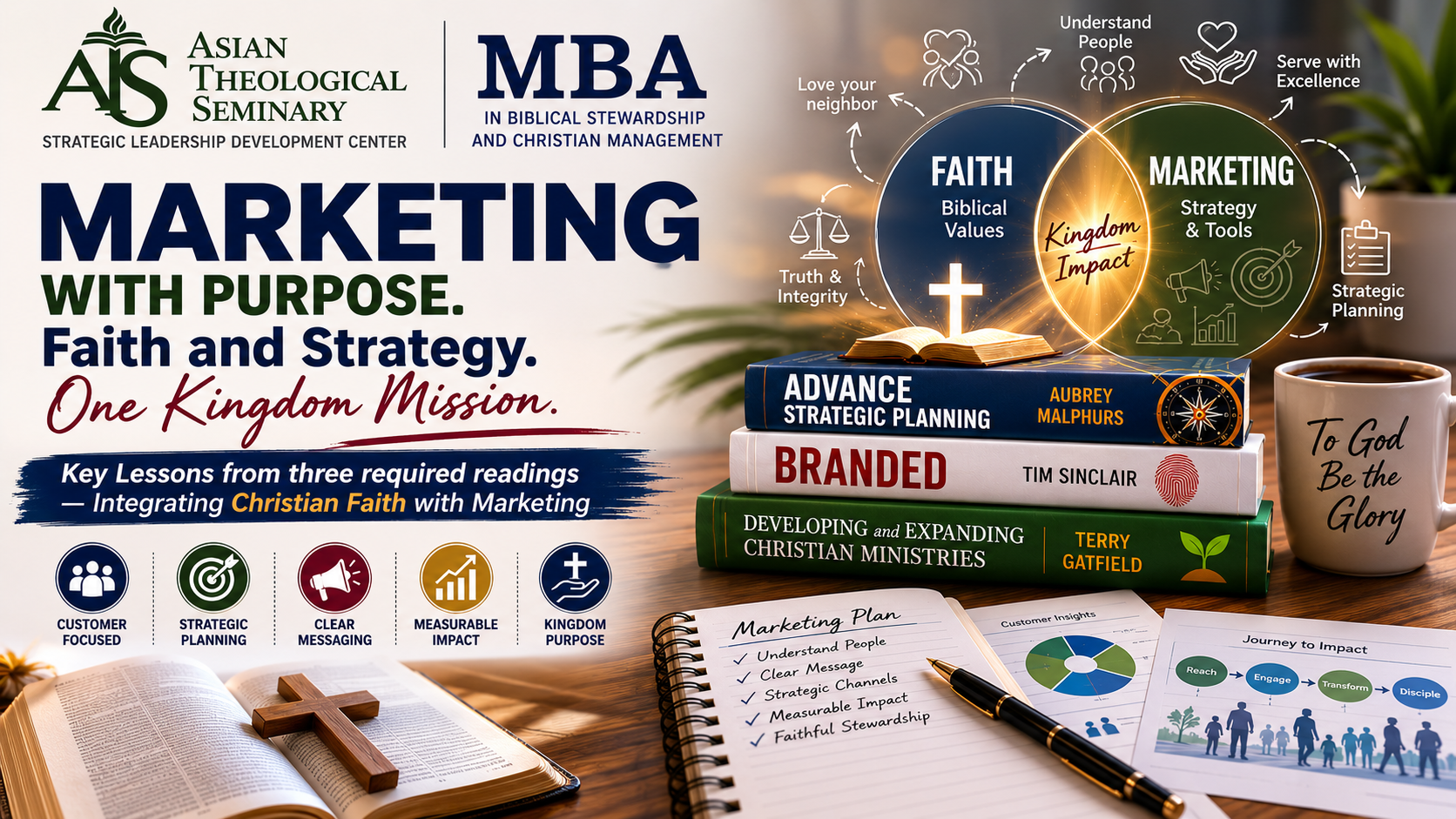
As part of the requirements for the marketing subject in this program (taught by Mr. Jehrt Santos, an ATS MBA graduate and an experienced marketer and entrepreneur) we were assigned three books: Advance Strategic Planning by Aubrey Malphurs, Branded by Tim Sinclair, and Developing and Expanding Christian Ministries by Dr. Terry Gatfield. I want to share here what I have learned from these readings, how I plan to apply them, and what I believe they say together about the calling of Christian organizations and leaders in the marketplace and in ministry.
As always, I am grateful to ATS for offering a program like this. As far as I know, it remains the only MBA in the Philippines, and perhaps in all of Asia, that is grounded in a rigorous, Protestant-Evangelical, biblically faithful approach to business and management. It is affordable, the instruction is excellent, and the integration of faith and professional life runs through every course. If you are looking for a program that strengthens both your competence and your calling, I cannot recommend it highly enough.
Advance Strategic Planning by Aubrey Malphurs
Malphurs writes for church leaders who want to move beyond reactive, week-to-week ministry and into a more intentional, mission-centered way of operating. The book is essentially a comprehensive framework for building and sustaining a strategic plan for a local church, and its insights are relevant far beyond that context.
The first major lesson I drew from the book is what Malphurs calls mission-centric planning. The idea is straightforward but demanding in practice: every activity, every budget decision, every initiative must be traceable back to the core mission of the organization. This kind of clarity is harder than it sounds. Organizations, including churches, have a tendency to accumulate programs and commitments over time that may have served a purpose once but no longer connect meaningfully to the mission. Malphurs pushes leaders to do the difficult work of pruning and aligning, ensuring that what the organization does actually reflects what the organization is.
The second lesson is about strategic thinking as a discipline. Malphurs draws a useful distinction between leaders who react to circumstances and leaders who actively shape the future of their organizations. Strategic thinking means analyzing trends, anticipating challenges before they arrive, and setting clear objectives that give the organization a coherent direction. For churches that often operate in a kind of perpetual present tense, focused on the next Sunday and the next ministry event, this kind of long-range orientation is genuinely countercultural and genuinely necessary.
The third lesson is the importance of regular evaluation and assessment. A strategic plan that is written once and then filed away is of limited value. Malphurs insists on building in systematic processes for reviewing performance, gathering feedback, and measuring progress against stated goals. This ongoing loop of assessment and adjustment is what keeps a strategic plan alive and keeps an organization honest about whether its efforts are actually producing the outcomes it intends.
For our church, which is still in the early part of the growth phase of the organizational S-curve, these lessons are directly applicable. We will work on articulating our mission with greater clarity, developing a strategic plan that looks further ahead than we are accustomed to, and building in regular checkpoints to assess whether our growth is healthy and sustainable. We need scalable systems, stronger leadership development pipelines, and deeper community engagement, all oriented around the core calling God has given us.
Branded by Tim Sinclair
Tim Sinclair’s Branded approaches the intersection of faith and professional life from a personal angle. The book is less about organizational strategy and more about the individual believer’s calling to live with integrity and intentionality in every domain of life, including the workplace.
The first lesson is about integrating faith and work at the level of identity, not just behavior. Sinclair argues that the Christian life was never meant to be divided into a sacred compartment and a professional compartment. Our values, our ethics, our decision-making frameworks, these do not get suspended when we clock in. They are meant to be fully operative in everything we do, including how we lead, how we market, how we negotiate, and how we treat the people we work with and for.
The second lesson is authenticity and consistency. Sinclair is realistic about the gap that so often exists between what Christians profess and how they actually behave in professional settings. He challenges readers to close that gap, not through performance or impression management, but through genuine transformation that produces consistent character. Integrity, honesty, and transparency are not traits to display when convenient. They are the substance of what it means to be a Christian professional.
The third lesson is stewardship. Sinclair frames time, talent, and finances not as personal possessions but as gifts from God to be managed responsibly for purposes larger than oneself. This stewardship mindset reshapes how we think about resource allocation, about investment in people, and about the environmental and social dimensions of how we run our organizations.
In my own organizations, I plan to apply these lessons by creating regular forums for dialogue about faith and work integration, and by investing in training opportunities, including hopefully sending key leaders to institutions like ATS itself, where these questions are taken seriously. I also want to model the kind of authentic, consistent Christian character that Sinclair describes, understanding that people in my organizations are watching not just my policies but my life.
Developing and Expanding Christian Ministries by Dr. Terry Gatfield
Gatfield’s book is the most directly relevant to the marketing subject, in that it addresses how Christian organizations should think about promotion, outreach, and growth. His central argument is that marketing, properly understood, is not a secular technique imported awkwardly into ministry. It is a form of service, a means by which an organization connects its God-given mission with the real needs of the community it exists to serve.
The first lesson is understanding marketing as service. This reframing is important. When marketing is oriented around the purposes of God and the needs of people rather than around institutional self-promotion, it becomes a genuinely missional activity. The goal is not to build a brand for its own sake but to make visible the ways in which a ministry or organization is meeting genuine human needs in the name of Christ.
The second lesson is purpose-driven planning. Gatfield insists that planning in Christian organizations should begin with prayer and spiritual discernment, not with market analysis alone. This does not mean ignoring data or strategic tools. It means holding them within a larger framework of seeking God’s direction and aligning organizational efforts with what He is doing. The result is a kind of planning that is simultaneously rigorous and surrendered.
The third lesson is mission-driven organizational identity. Gatfield emphasizes the importance of articulating clear mission statements that are not just strategic documents but theological ones, expressions of the organization’s understanding of its role in God’s larger purposes. These statements should guide everything, from internal culture to external communication, ensuring that the organization’s identity remains coherent and its witness remains credible.
In my organizations, whether business, church, or civic, I will apply Gatfield’s framework by adopting a genuinely service-oriented approach to marketing, one that asks not just how to attract attention but how to communicate real value to real people. We will engage in purpose-driven planning, regularly reviewing our activities against our mission and setting SMART goals that are anchored in our calling. And we will invest in developing a mission-driven identity that is clearly understood by every member of our team and consistently reflected in everything we communicate to the world.
Three Books, One Thread
What strikes me most about these three books is the thread that runs through all of them. Malphurs, Sinclair, and Gatfield are writing about different things, strategic planning, personal integrity, and ministry marketing respectively, but they are all ultimately making the same argument: that effectiveness and faithfulness are not in tension. That the most strategic thing a Christian organization or leader can do is to be deeply, consistently, authentically aligned with the mission God has given it. Everything else, including marketing, follows from that.
This is exactly the kind of integrated, biblically grounded thinking that the ATS program is training us to develop, and I am grateful for the opportunity to engage these ideas seriously. They are shaping not just how I think about marketing but how I think about leadership, organizational health, and the calling of Christian institutions in the world.
References
Gatfield, Terry. Developing and Expanding Christian Ministries. n.p.
Malphurs, Aubrey. Advance Strategic Planning: A New Model for Church and Ministry Leaders. Baker Books.
Sinclair, Tim. Branded: Taking Your Theology to Work. Moody Publishers.

Leave a Reply