
This blog post is a plain-language, easy-to-read version of a longer scholarly paper. If you prefer a more detailed, fully documented, and academically rigorous treatment of these issues, the complete scholarly paper is available for download at the end of this post. For those who prefer listening rather than reading, a companion Spotify podcast covering the entire series is also available near the end of this post.
A strategic suggestion for Vice President Sara Duterte to Resign, Redirect and Rise Again in 2028
The Philippines stands at a precarious crossroads. Its economy is stumbling, its institutions are strained, and its political theater has become a spectacle that alarms investors, exhausts citizens, and distracts policymakers from the nation’s most urgent work. At the center of this storm sits Vice President Sara Duterte, impeached for a second time, embattled, but by no means finished. The question is no longer whether she will survive the current political siege. The more important question is this: At what cost to the country? And at what cost to herself?
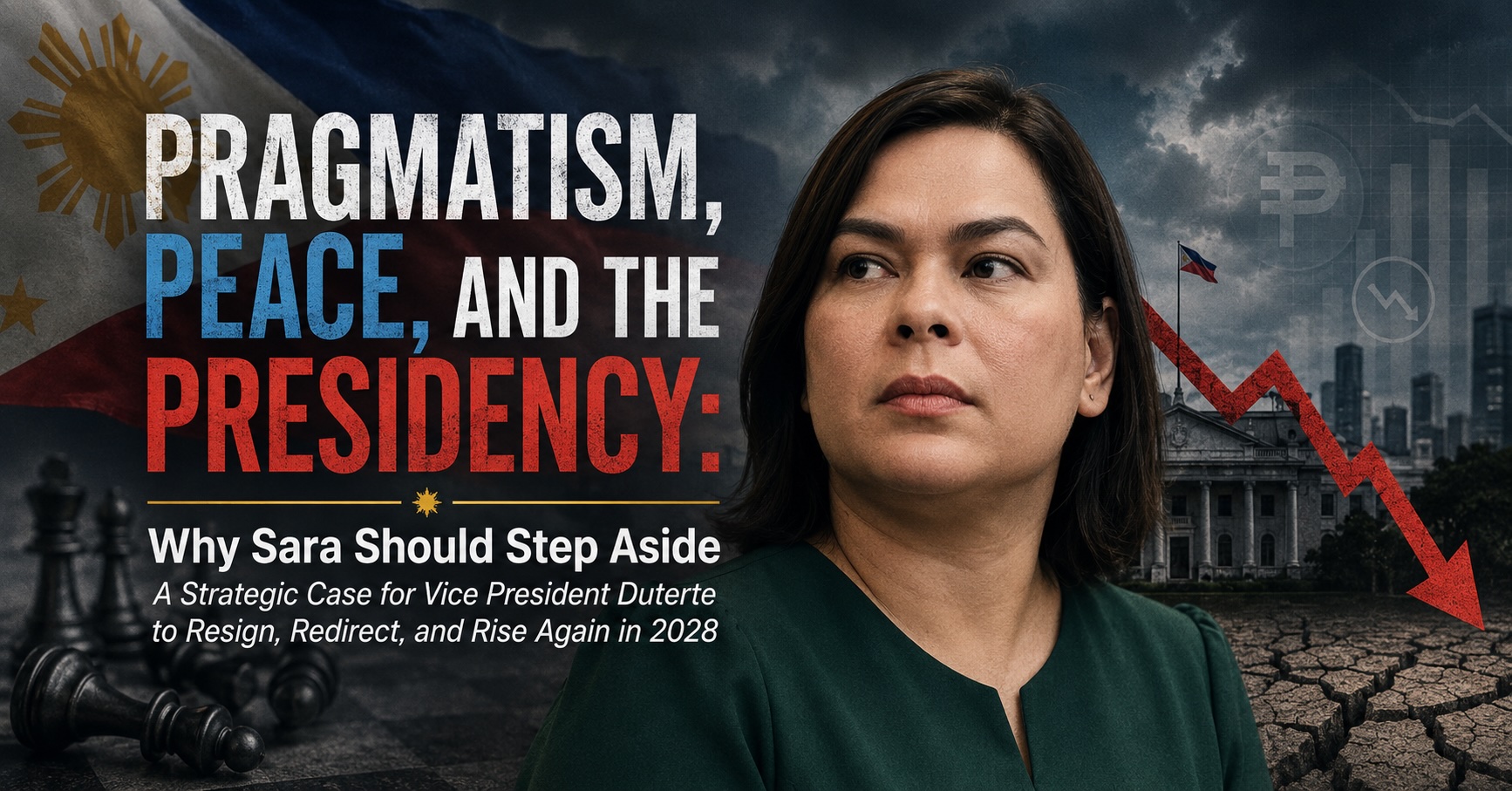
This article argues, on grounds of pragmatism, patriotism, and political strategy, that Vice President Sara Duterte should voluntarily resign from the vice presidency, not out of defeat, not as an admission of guilt, but as an act of statesmanship that clears the political air, rescues the economy from a prolonged crisis of confidence, and positions her for the presidency in 2028.
A note on method: This is a strategic policy essay, not a neutral empirical paper. It draws on verifiable institutional data, peer-reviewed scholarship, and credible journalism to establish the factual landscape, then advances a normative argument about what political actors ought to do given those facts. Where the article moves from documented evidence to political inference, that transition is made explicit. Readers should distinguish empirical claims, supported by cited sources, from strategic recommendations, which represent the author’s analytical judgment.
An Economy in Distress: The Stakes Could Not Be Higher
Before addressing the political drama consuming Manila, one must situate the argument in the broader economic reality facing 117 million Filipinos. The numbers are not flattering.
| 4.4%Full-year GDP growth 2025, slowest in five years | 3.0%Q4 2025 growth, weakest since Q1 2021 | 23%FDI decline, Jan–Sep 2025 vs. same period 2024 |
The Philippine economy posted full-year growth of just 4.4 percent in 2025, the slowest annual pace in five years and well below the Marcos administration’s target range of 5.5 to 6.5 percent (McKinsey, 2026). The fourth quarter was particularly alarming: GDP grew by only 3 percent, the weakest quarterly performance since Q1 2021 (Makati Business Club, 2026). The OECD has lowered its 2026 growth forecast to 5.1 percent, with recovery not expected until 2027 at the earliest (Makati Business Club, 2026). Meanwhile, the country’s neighbors are surging ahead.
| Economy | Relative Growth | Q4 2025 |
|---|---|---|
| Vietnam |
|
8.0%+ |
| Indonesia |
|
~5.1% |
| Malaysia |
|
~4.9% |
| Singapore |
|
~4.0% |
| Philippines ▼ |
|
3.0% |
Source: McKinsey & Company, Southeast Asia Quarterly Economic Review, Q4 2025
The ADB, in its April 2026 Asian Development Outlook, revised the Philippines’ GDP forecast downward to 4.4 percent for 2026, citing “rising global uncertainties,” particularly the Middle East conflict, and domestic headwinds (ADB, 2026). The IMF’s 2025 Article IV Consultation warned that risks are “tilted to the downside,” with political dysfunction cited alongside global trade uncertainty as a key drag (IMF, 2025). Net FDI inflows fell roughly 23 percent year on year in the first nine months of 2025 (BowerGroupAsia, 2025). The Philippines is losing ground relative to its neighbors at precisely the moment its political institutions are most visibly dysfunctional. The OECD’s 2026 Economic Survey warns of persistent weaknesses in foundational literacy, energy dependence on imported fossil fuels, and “administrative and bureaucratic challenges” that undermine investor confidence (OECD, 2026). These are the challenges that demand the full attention of government. Instead, the attention is elsewhere.
The Geopolitical Storm: A Nation That Cannot Afford Internal War
The political infighting in Manila is not occurring in a vacuum. The conflict between the United States, Israel, and Iran, and the resulting closure of the Strait of Hormuz, has shaken global energy markets and posed a direct threat to the Philippine economy’s two most critical lifelines: overseas remittances and energy imports (BusinessWorld, 2026). Fitch Ratings has explicitly warned that emerging markets including the Philippines could see a “substantial impact” on their credit rating if the Strait remains closed for more than a month (BusinessWorld, 2026). Oil shock has already pushed domestic inflation to 4.1 percent as of early April 2026 (BusinessWorld, 2026).
“A protracted conflict involving the United States, Israel and Iran could trigger oil price volatility, business contractions, or security risks that disproportionately affect this Filipino labor hub.”
Dr. Alicor Panao, Associate Professor, University of the Philippines, Philippine Daily Inquirer, 2026
OFW remittances totaled $35.634 billion in 2025, with 18.19 percent, or $6.481 billion, coming from the Middle East alone (BusinessWorld, 2026). The Philippines deploys roughly 2.3 to 2.5 million OFWs in Gulf Cooperation Council countries (Tiglao, 2026). DLSU economists Felipe, Sauler, Vedeja, and Paden warned that threats to these flows “compound already-deteriorating purchasing power due to foreseen inflation spikes, further undermining the role of private consumption to usher in rapid economic expansion” (Felipe et al., 2026). A 10-percent drop in remittances would mean a loss of roughly $3.5 to $4 billion annually, a scenario analysis rather than a confirmed outcome, but one that underscores the structural vulnerability (Tiglao, 2026). This is not the time for its leaders to be consumed by internal warfare.
Politics as the Centerpiece: Business Leaders Sound the Alarm
The Philippine business community has grown increasingly vocal about the cost of the Marcos-Duterte feud. The Makati Business Club documented how political turmoil triggered a 26.2 percent contraction in public construction spending in Q3 2025 alone (Makati Business Club, 2026). The Credendo Group’s country risk assessment explicitly observed that “political instability is hitting consumer and investor confidence and government policies” (Credendo, 2026). Fitch Ratings highlighted political instability as a risk to fiscal policy implementation, while Fortune magazine noted that “investor confidence has withered in the wake of a corruption scandal” and that the country “starts 2026 on a weaker footing” (Fortune, 2026; BowerGroupAsia, 2025). In political economy, what economists call “political risk premium,” the additional return investors demand as compensation for uncertainty, rises when the state appears unstable (Acemoglu & Robinson, 2012). The Philippines is paying this premium every day the conflict remains unresolved.
A Senate in Chaos, an Impeachment Without End
The Philippine Senate has undergone multiple leadership changes in a span of months, each connected to the Duterte impeachment saga. The first impeachment was voided by the Supreme Court in July 2025 on constitutional technicality (Al Jazeera, 2026). A second was passed by the House on May 11, 2026, with 257 votes in favor, 25 against, and nine abstentions (PBS NewsHour, 2026). On that same day, Senate President Sotto was ousted, replaced by Alan Cayetano, a political ally of the Duterte family (Rappler, 2026a).
“It seems that whenever there’s going to be a leadership change in the Senate, it’s centered on the impeachment of the vice president.”
Dennis Coronacion, Political Science Professor, University of Santo Tomas, PhilSTAR Life, 2026
The Philippines has now lived through one unconstitutional impeachment, a Supreme Court voiding, a one-year ban on re-filing, a second impeachment, and two Senate leadership overhauls, all within roughly 18 months. Juan Linz (1990) long warned that presidential systems are particularly vulnerable to executive-institutional conflict, where “the rigidity of fixed terms” prevents resolution and produces “zero-sum games” with high costs for governance quality. The impeachment process, designed as an exceptional constitutional check, has become a recurring political weapon.
The Pragmatic Case: Resignation Ends the Game
The most immediately operative argument for Vice President Duterte’s voluntary resignation rests on a strategic intersection of constitutional ambiguity and established political practice. Under Article XI, Section 3(7) of the 1987 Philippine Constitution, an impeachment conviction carries two distinct penalties: removal from office and perpetual disqualification. Crucially, Philippine jurisprudence has not conclusively resolved whether resignation terminates Senate impeachment jurisdiction, particularly regarding the constitutional penalty of disqualification from future office. While strict textualists might argue that the Senate theoretically retains jurisdiction to pursue this secondary penalty, the historical practice of the Philippine Congress has consistently been to treat the resignation of an impeachable official as rendering the trial moot and academic.
By leveraging this historical precedent, a voluntary resignation would likely dissolve the Senate trial. Critically, this deprives the Marcos administration of its most potent political instrument: the threat of a formal conviction and the consequent perpetual disqualification of Sara Duterte from public office. A voluntary resignation, operating outside a formal conviction, carries no such disqualification consequence; it preserves her legal standing, her constitutional eligibility for future office, and her political capital intact.
The literature on executive-legislative deadlock in presidential systems provides theoretical grounding for why institutions readily accept this off-ramp. As Cheibub, Przeworski, and Saiegh (2004) demonstrate in their comparative study of parliamentary and presidential systems, deadlocks in presidential regimes where removal requires extraordinary supermajorities, produce worse governance outcomes than early exits that restore institutional equilibrium. The current Philippine configuration illustrates this dynamic: a fixed-term executive conflict consuming institutional resources at rates disproportionate to any achievable outcome, making the tacit acceptance of a resignation the most pragmatic institutional resolution.
The Strategic Case: The Presidency Awaits in 2028
Sara Duterte formally announced her 2028 presidential candidacy on February 18, 2026 (TIME, 2026). She continues to lead in public opinion polling about presidential succession (TIME, 2026). Professor Jean Encinas-Franco of the University of the Philippines has observed that “the manner in which the impeachment trial will play out before the public will shape how voters will look at her candidacy” (TIME, 2026). Philippine Presidents are constitutionally limited to a single six-year term. Marcos cannot run again in 2028. This is a structural gift to any credible opposition candidate, and Sara Duterte, with her name recognition, her family’s regional strongholds in Mindanao, and her record as Davao City mayor, is uniquely positioned to receive it. A voluntary resignation, framed not as retreat but as principled rejection of a politically motivated process, could dramatically recast her public image. In Philippine political culture, where martyrdom and sacrifice carry powerful resonance, this narrative is not merely tenable. It is potentially decisive (Huntington, 1968).
Why Sara, Not Marcos: The Asymmetry of Political Futures
If the Marcos-Duterte feud is tearing the country apart, why should it be Sara who blinks? The answer lies not in moral symmetry but in structural asymmetry: the radically different political futures available to each protagonist.
| Dimension | Sara Duterte | Marcos Jr. |
|---|---|---|
| Electoral future | Presidential frontrunner, 2028 | Constitutionally barred from re-election |
| Age & horizon | 46 years old, multiple cycles ahead | Serving final years of mandate |
| Incentive to concede | High, protects a large future stake | None, no future election to protect |
| Risk of conviction | Perpetual disqualification from office | N/A, is the president |
| Cost of status quo | Daily erosion of presidential campaign time | Political embarrassment only |
Marcos is constitutionally barred from re-election. He will vacate Malacañang in 2028 regardless of what happens next. He has no electoral future to protect and therefore no strategic incentive to concede. He is already in his final chapter and must govern through to its last page. Sara Duterte’s situation is the mirror opposite. Game theory is precise here: in bargaining models of political conflict, the party with the longer time horizon and the larger future stake has the stronger incentive to make the short-term concession (Fearon, 1995). Her long-term stake, the presidency, is worth far more than the vice presidency she currently holds. A conviction carries perpetual disqualification. Voluntary resignation eliminates that risk entirely. Marcos must finish his term. He has no choice and no alternative. Sara Duterte has both.
The Constitutional and Succession Argument
The office of the Vice President of the Philippines is constitutionally designed as a position of succession and political redundancy, not of executive power. The Vice President has no direct constitutional portfolio of governance (Constitution of the Republic of the Philippines, Art. VII, Sec. 3). Under Marcos, Duterte was stripped of her Cabinet position as Secretary of Education. She holds no executive function and leads no department. Her political influence derives from her electoral mandate and her 2028 ambitions, not from the vice presidency itself. Duterte is expending enormous personal, financial, legal, and political capital defending a position that confers almost no executive power, while simultaneously destabilizing the institutions she would need to govern effectively as President. The cost-benefit analysis is unfavorable.
The Moral Argument: The Nation’s Suffering Demands Statesmanship
The Filipino people are suffering. Inflation is rising. Remittances face elevated risk. Growth is slowing. Schools are failing. The flood-control corruption scandal has cost the country an estimated $2 billion in misallocated public works (Fortune, 2026). The Philippine Stock Exchange lost approximately 1.7 trillion pesos in market capitalization in October 2025 at the height of the crisis (Makati Business Club, 2026). Public debt has climbed to P18.13 trillion, with the debt-to-GDP ratio reaching 63.2 percent by end-2025, the highest in 20 years (Rappler, 2026b). And yet the political conversation in Manila is consumed not by solutions to these crises, but by the procedural combat of impeachment, counter-impeachment, and Senate coups.
Amartya Sen (1999), in Development as Freedom, argued that genuine development requires not merely economic growth but the expansion of substantive freedoms, including political freedoms and institutional integrity. When political dysfunction systematically undermines the capacity of a state to deliver development, the moral imperative falls on its leaders to act in ways that restore that capacity. Sara Duterte has the political standing, the popular support, and the strategic horizon to make precisely this kind of choice.
The Polling Paradox: She Is Winning the War She Does Not Need to Fight
Perhaps the most compelling argument for resignation is the one Sara Duterte’s own supporters are least likely to acknowledge: she is already winning the 2028 presidential race, and the impeachment battle she is fighting so fiercely may be the greatest threat to that lead.
Multiple polling firms, surveying across different methodologies and timeframes, consistently show her as the frontrunner. The WR Numero Philippine Public Opinion Monitor, conducted March 10 to 17, 2026, with 1,455 respondents and a margin of error of ±3 percent, showed Duterte at 36 percent in a multi-candidate field, a 17-point lead over her nearest rival Senator Raffy Tulfo at 19 percent, and former Vice President Leni Robredo at 16 percent. Far behind were Senators Bong Go at 4 percent, Bam Aquino at 3 percent, and Kiko Pangilinan at 1 percent (WR Numero, 2026). This 36 percent figure represented a 3-point increase from November 2025, suggesting her support was growing even as the impeachment proceedings intensified.
In head-to-head scenarios, the Pulse Asia survey conducted February 27 to March 2, 2026, with 1,200 respondents and a margin of error of ±2.8 percent, showed Duterte leading Robredo 51 percent to 43 percent in a direct matchup. Her regional dominance is particularly striking: she led Robredo 93 percent to 6 percent in Mindanao, 67 percent to 31 percent in the Visayas, and was effectively tied in Metro Manila at 41 percent to 42 percent (Philstar, 2026). OCTA Research’s first-quarter 2026 Tugon ng Masa survey, conducted March 19 to 25 with 1,200 respondents, confirmed the pattern, placing Duterte at 46 percent against Robredo’s 35 percent in a direct head-to-head, with 19 percent undecided (GMA Network, 2026; BusinessWorld, 2026).
The South China Morning Post, reporting on the WR Numero findings, noted that analysts attributed her lead to “a hardened core of Duterte loyalists, sympathy over the International Criminal Court’s detention of her father, former president Rodrigo Duterte, and a lack of credible opposition alternatives with no stand-out challengers in sight” (SCMP, 2026). Analysts at OCTA observed that Duterte commands “a broad and electorally efficient coalition,” with support strongest in Mindanao at 88 percent and the Visayas at 53 percent, giving her a geographic advantage that is structurally difficult for any challenger to overcome (GMA Network, 2026).
It must be noted honestly that the race is not static. The most recent survey by Tangere, conducted May 8, 2026, showed Duterte still leading in a multi-candidate field at 39 percent but declining four points, with Tulfo rising to 25 percent and Robredo holding at 27 percent. In a simulated head-to-head between Duterte and Tulfo, the survey showed Tulfo narrowly ahead 45 percent to 44 percent, within the margin of error of ±2.77 percent (Manila Times, 2026). The OCTA tandem survey released May 14, 2026, showed a Robredo-Tulfo tandem leading a Duterte-Marcos tandem 44 percent to 40 percent, though OCTA itself cautioned that the 4-point gap “should be interpreted cautiously given the survey’s ±3% margin of error” (Inquirer, 2026).
This is precisely where the argument for resignation sharpens. Sara Duterte’s polling lead, while real and substantial, is not static. It is being eroded in real time by the very battle she is fighting. Every week of impeachment proceedings, every Senate coup, every front-page corruption allegation keeps her locked in a defensive posture rather than an offensive presidential campaign. The Tangere data showing Tulfo narrowing the gap, and the OCTA tandem data showing a competitive Robredo-Tulfo pairing, are early warning signals that the political price of the impeachment fight is being paid directly in polling points. She is spending political capital she needs for 2028 to defend an office that gives her no executive power today. The rational calculus is clear: step down, preserve the lead, and campaign from a position of moral authority rather than embattled incumbency.
Conclusion: Step Back to Leap Forward
The argument presented here is not one of defeat or diminishment. It is an argument of strategic intelligence. The Philippines cannot afford to remain in its current state of political paralysis. Its economy is slowing while its neighbors surge. Its institutions are destabilized by repeated Senate coups. Its investors are fleeing to more predictable markets. Its people are paying higher prices for fuel, food, and everything that oil touches, all while an external war threatens the remittances their families depend on.
And here is the ultimate irony: Sara Duterte does not need to win this fight. She is already winning the only fight that matters. Every credible polling firm in the country — WR Numero, Pulse Asia, OCTA Research, Tangere — shows her as the frontrunner for the 2028 presidency. She leads in multi-candidate fields by 17 points. She leads in head-to-head matchups. She dominates in Mindanao and the Visayas with margins that no challenger can realistically close. The presidency is hers to lose. And the most efficient way to lose it is to spend the next two years trapped in an impeachment trial, bleeding polling points, burning political capital, and giving her rivals the time and space to consolidate against her. The Tangere survey of May 8, 2026 already shows Tulfo narrowing the gap. The OCTA tandem survey of May 14, 2026 shows a Robredo-Tulfo pairing becoming competitive. The clock is running. Every day in the dock is a day not spent on the campaign trail.
And here is the ultimate irony: Sara Duterte does not need to win this fight. She is already winning the only fight that matters. Every credible polling firm in the country — WR Numero, Pulse Asia, OCTA Research, Tangere — shows her as the frontrunner for the 2028 presidency. She leads in multi-candidate fields by 17 points. She leads in head-to-head matchups. She dominates in Mindanao and the Visayas with margins that no challenger can realistically close. The presidency is hers to lose. And the most efficient way to lose it is to spend the next two years trapped in an impeachment trial, bleeding polling points, burning political capital, and giving her rivals the time and space to consolidate against her. The Tangere survey of May 8, 2026 already shows Tulfo narrowing the gap. The OCTA tandem survey of May 14, 2026 shows a Robredo-Tulfo pairing becoming competitive. The clock is running. Every day in the dock is a day not spent on the campaign trail.
Resignation as a private citizen removes the jurisdictional basis for the Senate trial entirely, dissolving the Senate’s occupation with political theater and freeing the nation’s institutions to focus on governance.
The path to the presidency is clearer from private citizen than from embattled officeholder. Every day in the dock is a day not spent building the coalition, the platform, and the narrative that 2028 demands.
A constitutionally term-limited president has no electoral future to protect and no reason to concede. Sara Duterte has both a future and a choice. That asymmetry makes resignation the strategically dominant option for her, not for him.
Vice President Sara Duterte should resign not because her political enemies have won, but because the Philippines cannot afford the price of the fight being waged in her name. The Filipino people deserve a government focused on their welfare, not on the perpetuation of a dynastic feud.
A leader who chose country over office, who refused to allow political warfare to paralyze a nation’s economy while its people suffer, is a more compelling figure than a vice president who fights to the end of a trial that distracts everyone from the work of governance.
A Theological Meta-Framework: Synthesis and Integrating Perspective
While this analysis has primarily engaged questions of political strategy, constitutional structure, institutional stability, economics, and governance, the deeper implications of the present crisis ultimately transcend politics alone. Political authority carries moral responsibility. Leadership is not merely the exercise of power, but the stewardship of public trust under conditions of moral accountability.
From a theological perspective, institutions exist not merely to preserve order, but to promote justice, peace, human flourishing, and the common good. Political conflict that continuously weakens governance capacity, economic stability, and social cohesion imposes real consequences upon ordinary citizens. At times, the exercise of restraint, sacrifice, and statesmanship may therefore reflect not political weakness, but moral strength.
“Let each of you look not only to his own interests, but also to the interests of others.”
Philippians 2:4 (ESV)
While originally written within an ecclesial context, the ethical principle articulated by the Apostle Paul possesses broader implications for public leadership and civic responsibility. Political leaders, especially during moments of institutional crisis, bear a moral obligation to consider not only personal, partisan, or factional interests, but also the broader welfare of the nation and the long-term stability of its institutions.
As an independent scholar and researcher, I am deeply drawn to viewing reality through multidisciplinary, cross-disciplinary, and transdisciplinary lenses, with theology serving as the integrating and guiding interpretive framework through which questions of politics, governance, ethics, economics, human flourishing, and social order are ultimately understood. Accordingly, while this article engages political theory, constitutional analysis, economics, institutional studies, and strategic reasoning as distinct analytical disciplines, I ultimately seek to synthesize these findings within a broader theological and moral framework that provides their deeper interpretive coherence and normative direction.
Full Scholarly Paper
Pragmatism, Peace and the Presidency: A Strategic Analysis of the Case for Vice President Sara Duterte’s Voluntary Resignation and Electoral Repositioning for 2028
This blog post is the accessible, plain-language version of a longer and more technical scholarly paper. If you want the deeper analysis with full theoretical grounding, expanded data, and academic documentation, the complete paper is available for download.
Listen to the Companion Podcast
The Deep Dive: Episode 5 – Pragmatism, peace and the Presidency: Why Sara Should Step Aside
Prefer to listen instead of read? This episode walks through the same analysis in conversational form. Listen below on Spotify.
Don’t have Spotify yet? It’s free to download on iOS, Android, and desktop. While you’re there, hit Follow on zdiaz.com | Life Hacks for Polymaths: The Deep Dive so new episodes land in your library automatically.
References
- Acemoglu, D., & Robinson, J. A. (2012). Why nations fail: The origins of power, prosperity, and poverty. Crown Publishers.
- Al Jazeera. (2026, May 11). Philippine Congress impeaches VP Sara Duterte for second time. aljazeera.com
- Asian Development Bank. (2026, April 10). Philippine GDP growth to remain subdued amid global uncertainty [Press release]. adb.org
- BowerGroupAsia. (2025, December 19). Philippines forecast: Governance reforms, steady growth and investor-friendly policies. bowergroupasia.com
- BusinessWorld Online. (2026, April 27). Sara keeps lead in presidential poll. bworldonline.com
- Cheibub, J. A., Przeworski, A., & Saiegh, S. (2004). Government coalitions and legislative success under presidentialism and parliamentarism. British Journal of Political Science, 34(4), 565–587.
- Constitution of the Republic of the Philippines (1987). Article VII, Sections 3, 4; Article XI.
- Credendo Group. (2026, February 3). Philippines: Political fragmentation, heightened public defiance and geopolitical risks might weigh on the 2026 outlook. credendo.com
- Encinas-Franco, J. (2026, May 11). Quoted in: Philippine VP Sara Duterte impeached, again. TIME. time.com
- Fearon, J. D. (1995). Rationalist explanations for war. International Organization, 49(3), 379–414.
- Felipe, J., Sauler, M. M., Vedeja, G., & Paden, S. P. (2026, March 17). Middle East war could trigger inflation, slow Philippine growth. Manila Bulletin. mb.com.ph
- Fitch Ratings. (2026, March 9). Mideast war poses credit risks to PHL. BusinessWorld. bworldonline.com
- Fortune. (2026, January 14). The Philippines, ASEAN’s new chair, starts 2026 on a ‘weaker footing.’ fortune.com
- GMA Network. (2026, April 27). VP Sara leads 46% while Leni rises to 35% in 2028 polls matchup per OCTA survey. gmanetwork.com
- Huntington, S. P. (1968). Political order in changing societies. Yale University Press.
- IMF. (2025, November 24). IMF Executive Board concludes 2025 Article IV Consultation with the Philippines. imf.org
- Inquirer. (2026, May 14). Robredo-Tulfo leads Sara-Imee in OCTA hypothetical 2028 survey. inquirer.net
- Linz, J. J. (1990). The perils of presidentialism. Journal of Democracy, 1(1), 51–69.
- Makati Business Club. (2026, January 29). Economy insights: GDP report Q4 2025 YoY. mbc.com.ph
- Manila Times. (2026, May 8). Tulfo gains ground in 2028 presidential race, even dislodging Sara in hypothetical direct contest — survey. manilatimes.net
- McKinsey & Company. (2026, March 27). Southeast Asia quarterly economic review: Q4 2025. mckinsey.com
- OECD. (2026). OECD economic surveys: Philippines 2026, sustaining growth and stability amid headwinds. oecd.org
- Panao, A. L. (2026, March). Quoted in: Gulf conflict poses direct economic risk to Philippines. Philippine Daily Inquirer. inquirer.net
- PBS NewsHour. (2026, May 11). Philippine vice president impeached over suspected wealth and threats. pbs.org
- Philstar. (2026, May 5). Leni cuts Sara’s wide lead in hypothetical 2028 Pulse poll. philstar.com
- PhilSTAR Life. (2026, May 12). What the Senate coup means for Sara Duterte’s impeachment trial. philstarlife.com
- Rappler. (2026a, May 11). Sotto ousted as Senate president, Alan Cayetano takes over. rappler.com
- Rappler. (2026b, March). US-Iran conflict and the Philippine economy. rappler.com
- Sen, A. (1999). Development as freedom. Oxford University Press.
- South China Morning Post. (2026, April 10). Sara Duterte leads early 2028 Philippine presidential poll as rivals struggle to unite. scmp.com
- SunStar Davao. (2026, April 10). VP Sara maintains lead in 2028 presidential race. sunstar.com.ph
- Tiglao, R. (2026, April 1). Iran war’s hidden bombshell: The collapse of the OFW safety valve. rigobertotiglao.com

Splendid geopolitical Analysis…. Two thumbs up Atty.
Thanks Pastor Muller! God bless.