
In my usual interaction with KJV onlyist online, I saw this (once again very annoying and misinformed) meme alleging that the New King James Version is a defective translation as opposed to the King James Version.
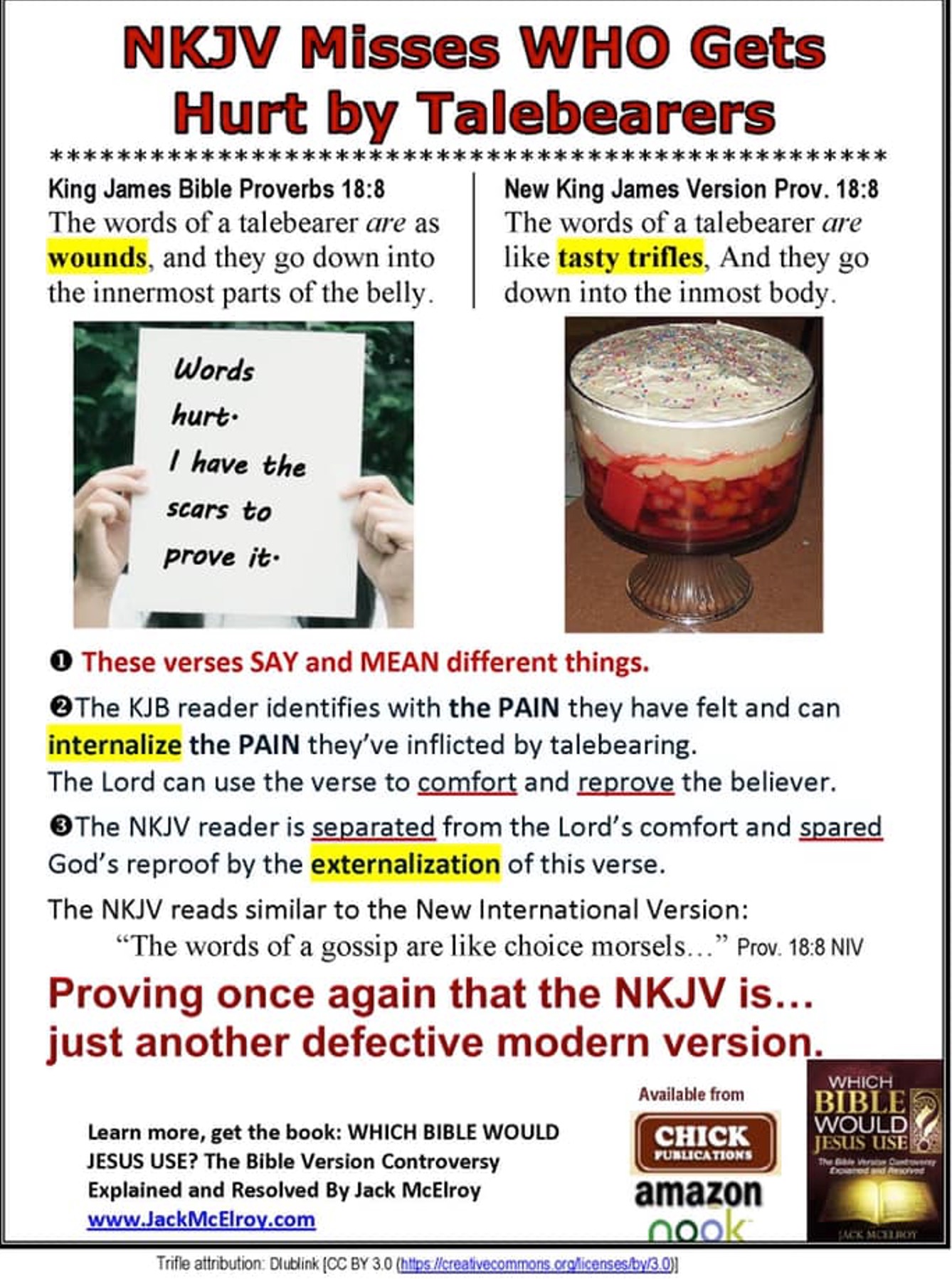
The problem issue is actually with the Hebrew word “laham” (לָהַם)This Hebrew word could either mean to burn in, ranke – wound or could mean swallow greedily, swallowed, dainties, delicacies, choice morsels, dainty morsels.
As in any word with multiple meanings, context is therefore the key to drawing out the right meaning of this word in this particular context.
The verse says “Prov. 18:8 The words of a talebearer are like ___________, And they go down into the inmost body.”
Now which would make sense ? Wounds going down into the inmost body or dainties, delicacies, choice morsels, dainty morsels ? Take note that whatever is likened to is likened to the “words of the talebearer.”
Obviously, dainties, delicacies, choice morsels, dainty morsels makes more sense as the words of a tale bearers are at first sweet to hear. As Max Anders comments in the Holman Bible commentary, “Hearing gossip is like eating choice morsels, literally, “things greedily devoured.” Too many of us snap up the latest tidbit of news, just as a glutton devours the latest delicacy. And when the gossip is received, it takes up a permanent place in the inmost parts, lodging in the memory and corrupting the soul.”
Further most Bible translators and scholars are of the opinion that indeed the best translation of this word is dainties, delicacies, choice morsels, dainty morsels.
The classic Pulpit commentary sheds light on this passage, “The verse recurs in Proverbs 26:22; but the word rendered “wounds” (mitlahamim) is to be differently explained. It is probably the hithp. participle of laham,” to swallow,” and seems to mean “dainty morsels,” such as one eagerly swallows. Thus Gesenius, Schultens, Delitzsch, Nowack, and others. So the clause means, “A whisperer’s words are received with avidity; calumny, slander, and evil stories find eager listeners.” The same metaphor is found in Proverbs 19:28; Job 34:7. There may, at the same time, be involved the idea that these dainty morsels are of poisonous character.”
Derek Kidner in the Tyndale commentary writes “Delicious morsels (RSV) is a more likely translation than AV’s wounds; modern scholars agree in deriving it from a verb ‘to swallow greedily”
Roland E. Murphy in the Word Biblical OT commentary comments “This verse appears also in 26:22, where it is perhaps more suitable to the context. See Note 8.a.* “Dainty morsels” is a common, if uncertain, translation. Experience bears out the attraction that gossip exerts over human beings; it enters deeply into a person; the”
So instead of this being used to prove that modern translations are wrong, this is one of those proof that the KJV translated it wrong. The KJV translators wouldn’t be surprised at all that they made a mistake on this considering that they themselves acknowledge that translations are not infallible and have imperfections and blemishes.
Don’t believe the lies of KJV Onlyism ! Know the truth !

Leave a Reply