
A pervasive question not only in Cognitive Archeology but also in all sciences using the evolutionary framework is this, when and how did the evolution of cognition take place? This has been the crux of the debate that has been raging since the early beginnings of the discipline. School of thoughts on this matter can […]
The Schlanger alternative: Understanding Cognition through a deeper understanding of the technological processes in the Levallois technique.
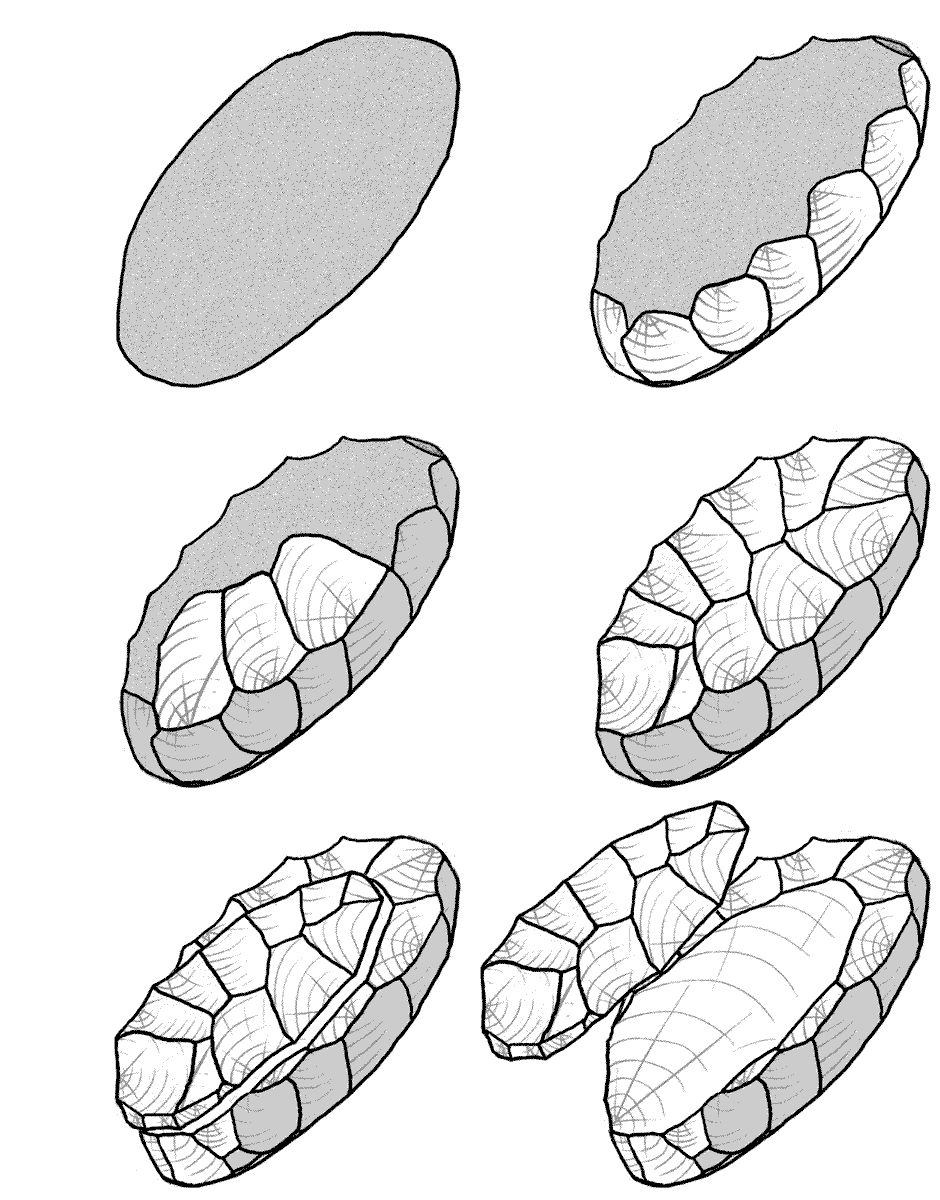
What mental processes run in the minds of pre-historic stone knappers when they made stone tools? Do they have already have a mental image in mind when the made their stone tools? Is their design deliberate or is the output merely a response to external circumstances and constraints? How do we hypothesize what goes inside […]
7 Reasons why “The Prehistory of the mind” has been more influential than anything that was written before in the history of Cognitive Archeology.
In 1996, former Cambridge University Lecturer in Archeology, Steve Mithen who also has a Ph.D in Archeology from Cambridge, published a book entitled “The Prehistory of the Mind” with the subtitle “A search for the origins of Art, Religion and Science.” In many respects, this book has been touted as being more influential than anything […]
Archeology’s take on symbolism and the evolution of language
Between the late 1980s and early 1990s, language evolution became the subject of focus in archeological circles. Among the most influential articles written on the matter is the article written by archeologists’ Iain Davidson and Pscyhologist William Noble’s entitled “The Archeology of Perception” published in 1989. Davidson and Noble’s paper is considered as the most […]
What the Piagetian perspective on the Palaeolithic revealed about the evolution of cognition that paleoarcheologist otherwise would not have known
In a nutshell the main thesis of the Piagetian perspective on Paleolithic evolution of cognition is that ontogeny recapitulates phylogeny. This simply means there is a parallelism between the development of a species’ thought processes and its evolution. Piaget himself called this idea as “a parallelism between the progress made in the logical rational organization […]