A reflection on the eve of Kadaugan sa Mactan.
This blog post is a plain-language, easy-to-read version of a longer scholarly paper. If you prefer a more detailed, fully documented, and academically rigorous treatment of these issues, the complete scholarly paper is available for download at the end of this post. For those who prefer listening rather than reading, a companion Spotify podcast covering the entire series is also available near the end of this post.
Tomorrow, Lapu-Lapu City marks Kadaugan sa Mactan, the annual commemoration of the Battle of Mactan on 27 April 1521, the encounter in which Ferdinand Magellan was killed and the first sustained European attempt to subjugate a Visayan polity was repelled. It is one of the most important civic rituals in Cebu, and arguably the oldest “anti-colonial” memory in the Philippine calendar.
It is also, this year (or should I say every year the Kadaugan Sa Mactan is celebrated), a celebration shadowed by a small but telling controversy.
The Facebook post that started this
A few days before the commemoration, a page associated with a well-known Lapu-Lapu City politician shared a Facebook post, a grid of AI-generated images, a roster of impossibly chiseled, oiled, eight-pack warriors holding a kampilan, posed against galleons. The caption, in Cebuano, reads: “Kinsa mas angayan mag Lapulapu?” (Who is more fitting to play Lapu-Lapu?) At the time of writing it has racked thousands of reactions, comments and hundreds of shares showing how interested the public is in this matter.
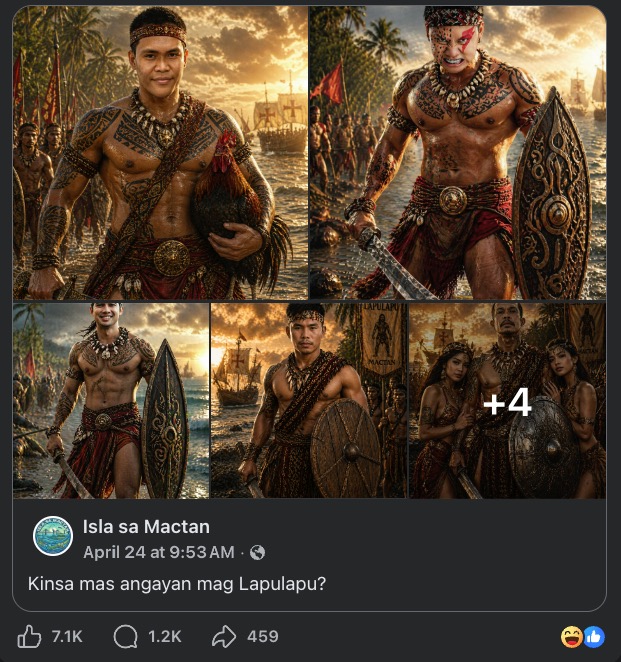
It looks harmless. It is not.
The post is the latest, and slickest, instance of a long pattern, the reduction of Lapu-Lapu to a CrossFit fantasy, a one-man action figure who personally killed Magellan in a duel on the beach. That image is satisfying. It is cinematic. It is also, according to the people who actually study the period, almost entirely wrong.
What the primary source actually says
The closest thing we have to an eyewitness account of the Battle of Mactan is the chronicle of Antonio Pigafetta, the Italian scholar who sailed with Magellan and survived the voyage. Pigafetta describes a chaotic shore battle in which the Spanish, weighed down by armor and stranded by low tide, were swarmed by an estimated 1,500 Mactan warriors. Magellan was struck by a bamboo lance in the face, slashed in the leg with a kampilan, and finished off as he fell, by multiple attackers at once (Pigafetta, 1906/2013).
Pigafetta does not name Lapu-Lapu as Magellan’s killer. He does not describe a duel. He does not even describe Lapu-Lapu being on the front line. The death he records is collective, a community defending a beach.
This is not a fringe reading. The National Historical Commission of the Philippines (NHCP, n.d.), in its official interpretation The Victory at Mactan, frames Lapu-Lapu as the leader of the resistance, the datu whose authority organized the defense and pointedly does not identify him as the man who personally landed the killing blow. Historian Ambeth Ocampo (2021) puts it bluntly in his Inquirer column, there is no primary document that proves Lapu-Lapu killed Magellan, and the popular insistence that he did is a later overlay on the sources, not a finding from them.
What recent scholarship adds
The most thorough modern reconstruction of the encounter is the work of Dr. Daniel “Danilo” Madrid Gerona, whose research is summarized in a recent long-form treatment by Dateline Ibalon (Gerona, 2025). Gerona’s argument is striking and worth repeating in full, based on a careful reading of Pigafetta and corroborating Iberian sources, Lapu-Lapu at the time of the battle was likely already of advanced age, possibly around seventy years old.
Gerona’s reading places him on the shore as a strategist and commander, not as a front-line slasher trading blows with Magellan in waist-deep water.
In other words, Lapu-Lapu won the Battle of Mactan because he was old enough, experienced enough, and politically powerful enough to make 1,500 warriors show up and hold the line, not because he had abs.
Where the muscle-bound hero comes from
If the historical Lapu-Lapu was a septuagenarian commander, where did the bare-chested, dueling demigod come from? Ocampo (2020) traces the image to twentieth-century nationalism, particularly post-independence efforts to give the new republic an indigenous founding hero who could rival the colonial pantheon. Monuments, textbook illustrations, comic books, and later film and television iteratively re-cast Lapu-Lapu in the mold of a Hollywood action lead. By the time the Freeman’s opinion pages observed in 2021 that scholarly consensus had decisively rejected the “single combat” narrative, the muscular myth had already been load-bearing in Philippine popular memory for two generations (The Freeman, 2021).
The AI-generated casting call is therefore not an innovation. It is the logical endpoint of a century of mythologizing, the moment when the cartoon hero finally becomes a render, optimized for engagement, and offered to the public as a vote.
Why this is dangerous, not just inaccurate
It is tempting to wave this off as harmless fun. A festival needs a face. A reenactment needs a star. So what if we cast a model? Here is what is actually at stake:
What to commemorate every Kadaugan sa Mactan
There is nothing wrong with celebration. Kadaugan sa Mactan should be loud, public, proud, and Cebuano. But the man at the center of it deserves the dignity of being remembered as he was, a senior datu, on a shore he knew, commanding warriors he had spent a lifetime gathering, who turned back a global empire on its first try.
That is the Lapu-Lapu who won. He does not need a six-pack. He needs us to read the sources.
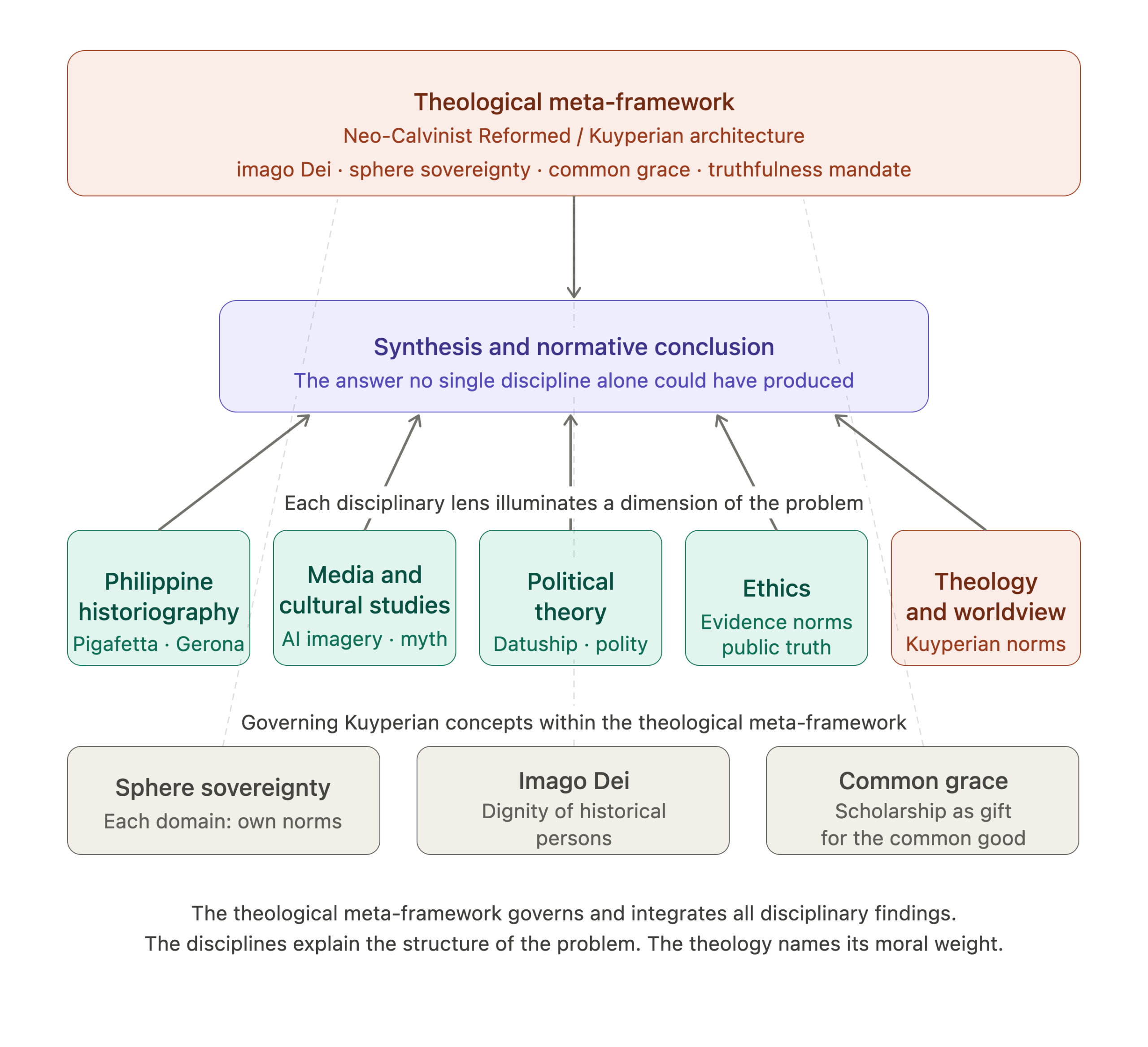
Theological Meta-Framework
A Neo-Calvinist Reformed and Kuyperian Reading of the Lapu-Lapu Mythology Problem
Everything in this paper, the history, the media criticism, the warning about AI-generated images, has been running on a deeper track. That track is theological. This section makes it explicit.
My approach to scholarship is grounded in the Neo-Calvinist Reformed tradition, the intellectual tradition of Abraham Kuyper, Herman Bavinck, and thinkers like Nicholas Wolterstorff. This is not incidental to my method. It is the architecture underneath it. The disciplines explain the structure of the problem. The theology names its moral weight.
1. The Ninth Commandment Is Not Just About Courtrooms
The Reformed tradition reads the prohibition on false witness much more broadly than most people do. It is not just about lying under oath. The Westminster Larger Catechism describes it as a positive obligation to protect and promote the truth in every area of life, including how we publicly represent other human beings, living or dead.
That has direct implications for a Facebook post presenting AI-generated muscle-warriors as the face of Lapu-Lapu. If scholarship has established, and it has, that this image has no basis in the primary sources, then circulating it is not a harmless exercise in creative liberty. It is a failure of the truthfulness obligation that the Reformed tradition places on every sphere of human activity. Not an intentional lie, perhaps. But a failure nonetheless.
2. Every Sphere Has Its Own Rules, and History Is One of Them
Abraham Kuyper’s most important contribution to social thought is probably his doctrine of sphere sovereignty. The idea is this: God has ordained different domains of human life, the family, the church, the state, science, art, commerce, each with its own internal rules and proper authority. No sphere gets to colonize another.
History is one of those spheres. It has its own norms: careful reading of primary sources, honest acknowledgment of what the evidence does and does not support, transparent representation of scholarly uncertainty. When the entertainment sphere or the political sphere, or the social media engagement sphere decides what the public “knows” about a historical figure and pushes aside the findings of careful scholarship, it is committing a sphere-boundary violation.
The AI-generated casting poll is precisely this. It is the entertainment and political spheres colonizing the historical sphere, and using the authority of a civic commemoration to launder the result.
3. Historical Knowledge Is a Gift, and Gifts Come With Obligations
Reformed theology teaches the doctrine of common grace: that God distributes gifts, intelligence, skill, scholarly capacity, the ability to dig through archives and reconstruct the past broadly across human society, not only among believers. These gifts are not for private benefit. They are entrusted for the common good of the communities they serve.
The historical knowledge in Pigafetta’s chronicle, in Gerona’s scholarship, in Ocampo’s journalism, in the NHCP’s official interpretation, all of that is a common grace gift entrusted to the scholarly community for the benefit of Philippine civic life. When it is systematically displaced by a muscular mythology optimized for social media shares, that gift is being squandered. Not through malice, but through the steady priority of spectacle over evidence.
4. Lapu-Lapu Was a Real Person, and Real People Bear God’s Image
The most foundational conviction of the Reformed tradition is that every human being bears the imago Dei (the image of God) and therefore possesses inherent dignity that no institution may override for convenience or entertainment. This applies to the dead as much as to the living.
Lapu-Lapu was a real human being. A senior datu of significant political sophistication who organized a genuine military defense of his community against armed foreign encroachment. He deserves to be remembered as what the evidence suggests he was not as the projection of twentieth-century nationalist fantasy onto a sixteenth-century Visayan shore.
To systematically replace him with a fictional construction, not because the evidence is ambiguous, but because the construction is more satisfying, is to violate the dignity of the person being misrepresented. It is a small violation by the standards of history’s great injustices. But it is a real one.
This theological framework does not claim that the politicians who shared the AI-generated images acted with malicious intent, that festival organizers are dishonest, or that anyone in this story is a villain. It claims something more precise: that the structural conditions under which popular historical memory is formed, nationalism, digital rendering tools, social media incentives, the commercial appeal of heroic spectacle, represent a pattern of sphere-boundary violation that the Reformed tradition is specifically designed to diagnose and name. Lapu-Lapu deserves better than a casting poll. He deserves the dignity of the primary sources.
📄 Full Scholarly Paper Available
This blog post is the accessible, plain-language version of a longer and more technical scholarly paper. If you want the deeper analysis with full theoretical grounding, expanded historical documentation, complete Kuyperian theological synthesis, and academic citations, the complete paper is available for download.
Full title: Myths, Muscles, and Mactan: The Lapu-Lapu We Keep Inventing — A Comprehensive Multidisciplinary, Crossdisciplinary, Interdisciplinary and Normative Transdisciplinary Scholarly Paper
Author: Zigfred Diaz | Date: May 2026
Listen to the Companion Podcast
The Deep Dive: Episode 8 – Myths, Muscles and Mactan: The Lapu-Lapu We Keep Inventing
Prefer to listen instead of read? This episode walks through the same analysis in conversational form. Listen below on Spotify.
Don’t have Spotify yet? It’s free to download on iOS, Android, and desktop. While you’re there, hit Follow on zdiaz.com | Life Hacks for Polymaths: The Deep Dive so new episodes land in your library automatically.
References
- Gerona, D. M. (2025, April). Mactan and Lapu-Lapu: Danilo Madrid Gerona. Dateline Ibalon. https://dateline-ibalon.com/2025/04/mactan-and-lapu-lapu-danilo-madrid-gerona/
- National Historical Commission of the Philippines. (n.d.). The victory at Mactan. https://nhcp.gov.ph/the-victory-at-mactan/
- Ocampo, A. R. (2020). How do we liberate ourselves from the past? Philippine Daily Inquirer. https://opinion.inquirer.net/129539/how-do-we-liberate-ourselves-from-the-past
- Ocampo, A. R. (2021). Did Lapulapu kill Magellan? Philippine Daily Inquirer. https://opinion.inquirer.net/139686/did-lapulapu-kill-magellan
- Pigafetta, A. (2013). The first voyage around the world (1519–1522): An account of Magellan’s expedition (Project Gutenberg ed.). Project Gutenberg. https://www.gutenberg.org/files/42884/42884-h/42884-h.htm (Original work published ca. 1525)
- The Freeman. (2021, April 27). Lapu-Lapu didn’t kill Magellan in single combat. The Philippine Star. https://www.philstar.com/the-freeman/opinion/2021/04/27/2094101/lapu-lapu-didnt-kill-magellan-single-combat
Further Reading
The list above is what this column actually leans on. The list below is for readers who want to step past op-ed columns and into the academic substrate, the heavyweight works that drove the historiographical shift this article describes.
Gerona, D. M. (2016). Ferdinand Magellan: The Armada de Maluco and the European Discovery of the Philippines — A Study Based on Primary Sources. Manila: Spanish Galleon Publisher.
Why read it: The 500+-page biography that anchors the modern shift in how Filipino historians read 1521, including the case for Lapu-Lapu’s advanced age. Built from Spanish and Portuguese archives most textbooks ignored for decades.
Escalante, R. R. (2024). The Quincentennial of the First Circumnavigation of the World in Retrospect. Philippiniana Sacra, LIX(180), 545–564.
Why read it: This retrospective frames the official state position on the 500th-anniversary commemorations, including the deliberate move away from the “solo killer” narrative toward leadership and collective victory.
Gonzales, R. C. (2024). Reel Hero: The Construct of Lapu-Lapu in Philippine Cinema. ResearchGate. Link
Why read it: A direct treatment of the “CrossFit fantasy” problem this column raises. Analyzes how the 1955 and 2002 Lapu-Lapu films iteratively re-shaped the hero’s body and bearing to fit the nationalist sensibilities of their decades.
Ocampo, A. R. (n.d.). Liberating ourselves from the past [Magisterial lecture]. Ateneo de Manila University. archium.ateneo.edu/magisterial-lectures/16
Why read it: The longer-form scholarly version of Ocampo’s newspaper argument: how the Magellan–Lapu-Lapu encounter has been re-imagined by each generation of Filipinos, and what reading the primary sources actually demands of us.
Scott, W. H. (1994). Barangay: Sixteenth-Century Philippine Culture and Society. Quezon City: Ateneo de Manila University Press.
Why read it: The standard reference for what a 16th-century Visayan datu actually was, the alliance networks, tribute systems, tattooing, and warfare that made a coordinated 1,500-warrior defense at Mactan possible. Older, but still the field’s touchstone.
Leave a Reply